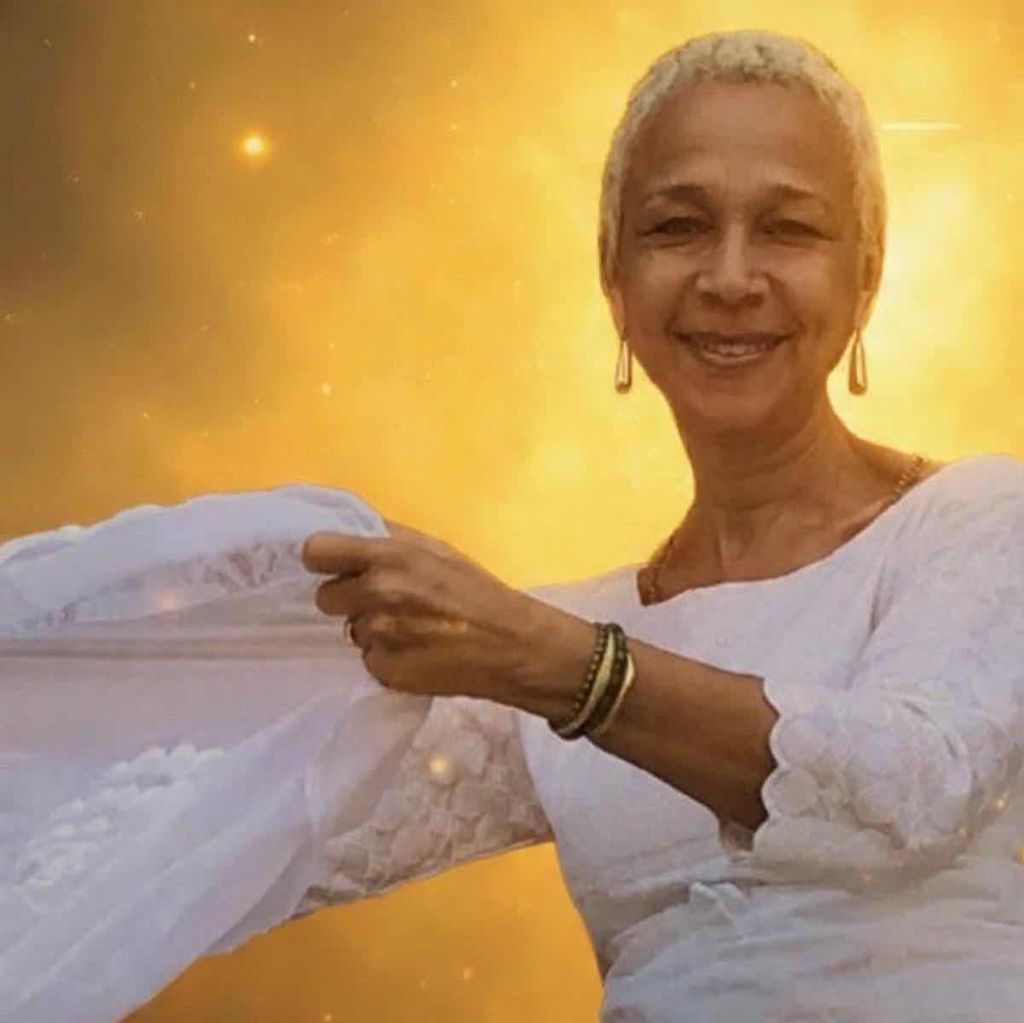
Awotunde Judyie Al-Bilali
1953 - 2026
Share Awotunde Judyie Al-Bilali's obituary with others.
Invite friends and family to read the obituary and add memories.
Stay updated
We'll notify you when service details or new memories are added.
You're now following this obituary
We'll email you when there are updates.
Please select what you would like included for printing:
Judyie was born to loving parents Lilian and George Brandt at Harlem Hospital in New York . She inherited her impeccable sense of style from her mother who was the first African American woman who built a million-dollar design label with her partner James Dougherty. From an early age, she was immersed in a haven of Black cultural pride. Her father was a salesman by trade and served as a sergeant in WWII. The war ended while he and his company were stationed in the South. George rented a private bus so that the Black soldiers in his charge could ride home in dignity avoiding the segregated buses of that time. This loving act left a deep imprint on her as well.
Her family lived in Lenox Terrace near the Schomburg Center for Black Research and Culture in New York City. In her self-published book, For the Feeling: Love and Transformation from New York to Cape Town, she describes the day her father brought home Miriam Makeba’s self-titled album. The image of Makeba with her short-cropped hair and royal blue dress captivated young Judyie who would go on to listen to the record over and over again. It is no surprise that she would fall in love with South African music and travel to Cape Town decades later.
As one of the first children of integration, Judyie attended Dalton High School where she graduated at the age of 16 and then made her way to Chicago to attend Northwestern University in the late 1960s. While there, another musician caught her attention: Muhal Richard Abrams. He was part of a burgeoning group of jazz musicians who founded the Association for the Advancement of Creative Music (AACM). Judyie joined AACM as a dancer where she learned about the deep connections between art, life, and liberation. These became foundational principles as she continued to live her life as an artist and a teacher. She would attend City College in New York before making her way to Amherst, MA where she crafted her own course of study focused on African American Performing Arts at the University of Massachusetts Amherst. After college, she continued to follow her heart and her passion for theater traveling for opportunities to perform. Notably, she performed in for colored girls who have considered suicide when the rainbow is enough and A Photograph, two plays by renowned playwright Ntozake Shange.
By the early 1980s, she was living in Louisville, Kentucky where she was fully engaged with arts and cultural production at places such as The Actors’ Theater of Louisville, The Bomhard Center Theater, and Four Corners. She met Shahid Al-Bilali in 1982, and in 1983, they were married. They enlisted a friend to lead the services in the recreation center where they often rehearsed plays together. Lillian Hanan Al-Bilali and Muhammad Salim Al-Bilali, their two children, were born in Louisville. Hanan made her entrance in the evening after one of Judyie’s performances in 1984 and Muhammad was born in 1986.
She and her family moved to New York in 1988 when she accepted a job at Crossroads Theatre Company in New Brunswick, New Jersey. Shahid joined the company as the master carpenter. At that time, the couple bought a house on Martha’s Vineyard, a place where Judyie spent cherished time as a child. This home provided solace when she faced the first cancer diagnosis of her life in the early 1990s.
At this point, it is clear that movement is one of her defining characteristics. She moved her family to Amherst, Massachusetts in 1997 where she embarked on graduate study in theater at the University of Massachusetts Amherst. During this time, she worked with New WORLD Theater and founded her own company dark moon collective. Her love of Black people and Black movements for liberation led her to South Africa. She made her first trip with support from the Augusta Savage Gallery in 2002 and would go on to earn a Fulbright to continue her work in Cape Town. As a Fulbright Senior Scholar, she launched Brown Paper Studio, an applied theater methodology, in Cape Town in 2004. She spent a decade nurturing this transformative program at the University of the Western Cape and Muhammad, her son, joined the company in its early years.
Judyie then made her way back to Amherst, MA where she was invited to direct Venus by Suzan-Lori Parks in the Department of Theater at Umass Amherst in 2012. The following year, she joined the faculty with a joint appointment between the theater department and Commonwealth Honors College, where she served as the program director for theater. She was also an affiliated faculty member with the W. E. B. Du Bois Department of Afro-American Studies and a beloved member of Blacklist and Third Space, two programs for faculty of color. She took a leadership role with the Five College African Studies Council and brought expansive ideas to the work of this important group. Her notable directing projects in the department of theater include Venus in 2012; Wole Soyinka’s adaptation of The Bacchae of Euripides: A Communion Rite in 2020; The Black Playwrights Celebration in 2022; Many Patterns, One Cloth in 2023; and Unfinished Women Cry in No Man’s Land While a Bird Dies in a Gilded Cage by Aisha Rahman in 2025.
In addition to writing plays and poetry, she was a well-respected author whose publications include For the Feeling: Love & Transformation from New York to Cape Town (CreateSpace Independent Publishing Platform, 2012). She contributed two chapters to Black Acting Methods: Critical Approaches, edited by Sharrell Luckett and Tia M. Shaffer, (Routledge, 2017) as well as an essay titled “The Circle” in Imagined Theatres: South Africa, curated by Megan Lewis, (Routledge, 2017). She had recently completed her second book Between Tattoos: A Biomythography in Three Acts.
Judyie loved her students and held them in the highest regard, often continuing her mentorship with many of them in various ways including serving as an advisor to the Re-Emergence Collective, a group of budding theater artists largely comprised of UMass Amherst alums. Judyie often ended her messages to her members of her cherished communities with the words, “In Peace, Freedom & Community. Ashé”. This spoke to her steadfast belief in the power of coming together to create a more just world.
She is survived by her former spouse Shahid Al-Bilali, her daughter Lillian Hanan Al-Bilali, her son Muhammad Salim Al-Bilali and his family, wife Torkwase Love and children: Mia, Kai, and Ali. She has predeceased her older brother Reverend Canon George Brandt, Jr. There will be a celebration of her life on April 10, 2026 in Amherst, MA.
Awotunde Judyie Al-Bilali's Guestbook
Visits: 2
This site is protected by reCAPTCHA and the
Google Privacy Policy and Terms of Service apply.
Service map data © OpenStreetMap contributors