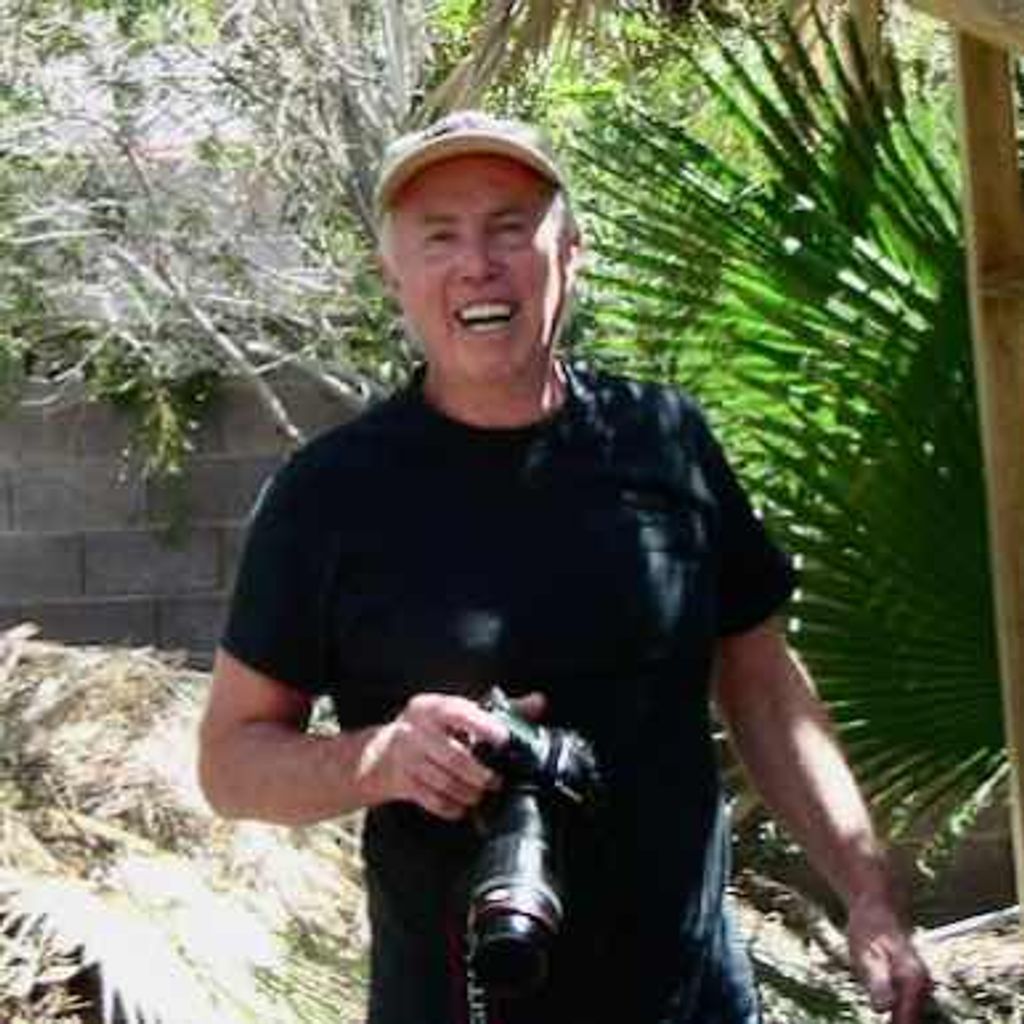
Donald Edward Carroll
1938 - 2026
Share Donald Edward Carroll's obituary with others.
Invite friends and family to read the obituary and add memories.
Stay updated
We'll notify you when service details or new memories are added.
You're now following this obituary
We'll email you when there are updates.
Please select what you would like included for printing:
Share Donald Edward Carroll's obituary with others.
Invite friends and family to read the obituary and add memories.
Stay updated
We'll notify you when service details or new memories are added.
You're now following this obituary
We'll email you when there are updates.
Please select what you would like included for printing:
Born on December 13, 1938, in Philadelphia, Pennsylvania, the only child of Anna Mary (née McLaughlin) and Joe Carper. His father was in the U.S. Navy and the family moved often during Don’s early childhood. They lived in many different locations in his early years—including Hawaii, Alaska, Boston, San Diego, and Newfoundland—before settling in Oklahoma.
Don Carroll (affectionately referred to as “DC” by friends and associates) was known for his ability to transform the abstract into the tangible, creating images that inspired imaginations and challenged conventional thinking. His life was dedicated to exploring new horizons, photographing the unseen, and pushing the boundaries of what was possible in visual storytelling. In addition to his work as a special effects photographer, he was an adventurer, lecturer, author, and filmmaker.
He was an active advertising and editorial photographer for nearly five decades, and a member of the American Society of Magazine Photographers. Don’s professional photography career started in Los Angeles, first shooting portraits of aspiring actors and his friend Lenny Bruce and, later, notable people such as Rod Steiger, Tony Randall, Senator Stuart Symington, and Secretary of Defense Clark Clifford. As he moved into doing more commercial work, including product advertising, he began to develop new techniques and custom built his own equipment to create his special effects images. Later, after moving and establishing his studio in New York City, he refined and expanded his techniques and inventions to focus almost exclusively on special effects.
Before digital photography became popular (pre-Photoshop), he lectured about special effects photography across the U.S., sharing techniques and encouraging photographers, designers, and creative directors to think and work out-of-the-box to create images existing only in the imagination.
His bestselling and groundbreaking book, Focus On Special Effects, published and co-written in 1982 with his first wife Marie Carroll (now Marie Noonan), served as a reference manual for photographers and creative directors around the world. It demonstrated the creative possibilities of how to photograph virtually anything the mind’s eye could envision, and how to achieve what seemed impossible by an understanding of simple principles of conventional photography combined with innovative and usually simple techniques, imaginative concepts, and careful planning. He created iconic conceptual images for corporate clients and also was one of the top-selling photographers whose work was licensed for commercial use by stock photo agency The Image Bank.
Don Carroll traveled the world—photographing erupting volcanos in Hawaii, shark feeding frenzies in the Bahamas, the wonders of hidden Himalayan villages—exploring and sharing his journey through the lens of his camera. Notably, he also developed the use of innovative techniques and specialized equipment to create images from perspectives or in contexts that were otherwise impossible to photograph in real-time. He traveled across the U.S.A. numerous times in a van he equipped with various cameras mounted to the roof, the bumpers, and beneath the chassis so that he could photograph images from all different perspectives as he drove through mountains, canyons, and plains of the U.S. for shots that might be used in his later imaginative creations. His unique images expressed a broad range of subjects and feelings: A whimsical shot of a dentist working on teeth from the point of view inside of the patient’s mouth; lab engineers and robots exploring the inner workings of printed circuit boards; an interplanetary astronaut walking in space approaching Saturn; neutrinos blasting serenely from the sun in a perfect light show between the moon and the Earth in the boundlessness of outer space.
A self-described dyslexic—Carroll left home at the age of fourteen and never finished his formal education—he was nonetheless an avid reader and autodidact, often sharing inspired quotes he connected with such as, “To see more is to become more,” and “That which you are seeking is seeking you.”
As a child, Don was very close to his mother and recalled their time together when they briefly lived in Hawaii because that was when she was most happy, according to him. He had a difficult relationship with his father during his youth and was estranged from him for most of his adult life. In the early 1990’s, with Noriko, he visited his father who was in a VA nursing home in Oklahoma. It was a major moment as he then learned of the PTSD that his dad had suffered having survived three shipwrecks and witnessed unspeakable horrors while in service with the U.S. Navy during World War II. He was grateful that he was able to come to a sort of peace with his father before he died in 1994.
Those who knew DC remember him with great love and respect. His colleagues admired his vision, creativity, and dedication, while family and friends share stories of his passion, energy, determination, resilience, loyalty, and sense of humor. When asked what he did for a living he would sometimes say, “I’m in the business of solving problems.”
Jay Reiburn, a New York based entrepreneur and a dear friend for nearly sixty years, said of him, “When I think of Don, memories rise instantly—the laughter, the stories, the sheer pleasure of being in his company. Don was the embodiment of ‘can-do.’ Nothing was impossible; obstacles were merely invitations. And yet, there was that beautiful paradox: A man who marched to his own drummer, who rejected conventional wisdom and shrugged off constraining social norms, who was at the same time almost disarmingly optimistic…Pollyanna-ish in the best sense; but, as we know, two things can be true at once. In Don, they harmonized. He was fearless. Roadblocks didn’t deter him; they energized him. He didn’t just overcome them—he beat them, whether packing up and moving to Vegas, transforming spaces, finessing problem situations, or enriching the lives of those fortunate enough to be in his orbit.”
Beyond his creative and commercial endeavors, Carroll also had a strong spiritual bent and a desire to help those less fortunate. One of his charitable projects, Focus On Famine, raised money to finance drilling a well for a town in Africa. It was in collaboration with a number of American photographers who contributed some of their work, and he traveled across the country to conduct photography workshops and lectures that were—according to his first wife Marie, who helped coordinate them and with whom DC always remained close friends—“brilliantly planned exercises for everyone to always have something to learn and do, and he talked for three days straight and was his usual self—funny, always irreverently polite, charming and (…did I say funny?) loving it! He was billed as ‘The World Famous Photographer, Don Carroll,’ and he used to say that people around the world were saying, ‘Who?’”
In 1988, a chance encounter with a young Buddhist monk while photographing the Potala Palace in Lhasa, Tibet, ultimately lead to a project featuring the Dalai Lama to help the Tibetan people. “It was like a lighting bolt,“ he later described his vision. “The entire image of the poster became crystal clear to me: I envisioned the Dalai Lama looking straight at me from over the Potala. Behind him were the snow capped Himalayas with storm clouds and an almost overpowering rainbow, showing the peace and beauty of Tibet.“ Carroll’s concept was that the poster he imagined would raise money for the relief of Tibetans living in refugee camps in India and Nepal. Back in New York he contacted and explained to the Dalai Lama’s representative, Rin Chin De Harlo, his idea for a poster entitled “ZONE OF PEACE.” Arrangements were made for a private photo shoot with His Holiness who was coming to America in three weeks. As Carroll later described it, “There were, however, three conditions: I must go to Los Angeles to make the picture; I could only have thirty minutes for the official sitting; (and) I must not ask him to remove his glasses.” At the photo shoot, he took a picture of His Holiness with a Polaroid to check the lighting and while it was developing he asked the Dalai Lama if he had seen the composition he put together for this poster. “Yes,” replied the Dalai Lama, “I think you should have someone more handsome than I. You would sell more posters.” Everyone laughed. The Polaroid was perfect and Carroll handed it to him. The Dalai Lama looked at it and said, “You made a very nice picture.” Carroll replied, "If you like it, you can use it on your driver's license for identification." And they both broke up laughing. Then he said, “I don't even have a car. Let me think. Do I know how to drive? I don't think so. Maybe the world is safer this way.” The entire room was in hysterical laughter at this point. His Holiness seemed to enjoy joking around and not being taken too seriously. Then, with some trepidation Carroll asked: ”Your Holiness, could you please remove your glasses? I have a bright white reflection in the dark lenses.” He could feel Rin Chin's breath on the back of his neck whispering, "No, No!” and the air was filled with 30 monks' recoiling with tension and sudden fear at his request. "I am sorry, Mr. Don Carroll. I am ruining your picture,” His Holiness replied, and his hands proceeded to remove the glasses. "Thank you, Your Holiness. Now, your people can look into your eyes,” Carroll said. The Dalai Lama smiled and said, "But I can see their eyes better with my glasses on.”
The “ZONE OF PEACE” poster came to fruition in November of 1989. Ten thousand posters were printed and distributed worldwide. The poster was made just prior to the 14th Dalai Lama being awarded the Nobel Peace Prize. The image Don originally envisioned in Lhasa, Tibet, and created with the cooperation of His Holiness, and the proceeds from poster sales fulfilled that desire in his heart to help to raise funds for the Tibetan refugees in India and Nepal who needed assistance and relief. In 1992, the Vogue magazine Paris edition reproduced Carroll’s image of the Dalai Lama from his “ZONE OF PEACE” poster image on the cover of the magazine. That issue, today, with his image on the cover is a collector’s item.
Carroll met his wife, Noriko, who is from Narita, Japan, while traveling on his way to Nepal and Tibet—where, coincidentally, he shot the pictures and had the vision for the Dalai Lama poster project. He saw her in an elevator at the Bangkok airport, as the doors opened. Their eyes met. “And it was,” he later recalled, “BANG! Love at first sight.“ They were married in 1992, joined by friends and family from around the world, at his three-story loft-studio at 188 Grand Street in the heart of New York City’s Little Italy section. Theirs was a beautifully balanced match and union for more than thirty years together. “She was my salvation,” he told friends, expressing his deep love for her.
Carroll’s innovative work and earlier success with conventional photographic processes predated the transformative revolution of the late twentieth century in digital imaging technologies with software and hardware tools such as Adobe’s Photoshop, Apple computers, and digital scanners, printers and cameras. Not one to be left behind by the disruptive progressive force of technology, in the early 1990’s Carroll augmented his New York City home-studio by adding a digital creative studio to form Concept Images with Noriko, along with her digital photo-illustration skills.
In early 2002, Don and Noriko moved from New York City to Nevada and further expanded their creative ventures to write, produce, and publish a number of books and films together, including Happy Birthday, the Cat, and the award winning documentary film, First Flight: A Mother Hummingbird’s Story, about a black-chinned hummingbird who built her nest on their backyard clothesline in Las Vegas. His achievements creating this and other important documentary films in collaboration with Noriko later in his career, in some ways, made him even more well known—especially among nature lovers, wild bird enthusiasts, and backyard birders—than he was as a commercial photographer.
Don’s legacy extends far beyond the images, books, and documentaries he created. He inspired countless photographers, artists, and creative directors, as well as people in all walks of life, who drew inspiration and courage from his unyielding creativity and willingness to tackle challenges head-on. His ability to see possibilities where others saw impossibilities—and bring them to life—was a testament to his enduring spirit.
In addition to his wife Noriko, he is survived by his family in Japan, including brother-in-law Nobuyoshi Iizuka (Fumie Iizuka, spouse); nephews and nieces Masayoshi, Mari, and Hiroyoshi; sister-in-law Yumiko Yuhara (Takuto Yuhara, spouse); and he also leaves behind their beloved cats, Sammy and Norton, and love birds, Pico and Pepper.
A celebration of life gathering to be held at a later date will be announced in the near future.
# # #
Donald Edward Carroll's Guestbook
Visits: 82
This site is protected by reCAPTCHA and the
Google Privacy Policy and Terms of Service apply.
Service map data © OpenStreetMap contributors