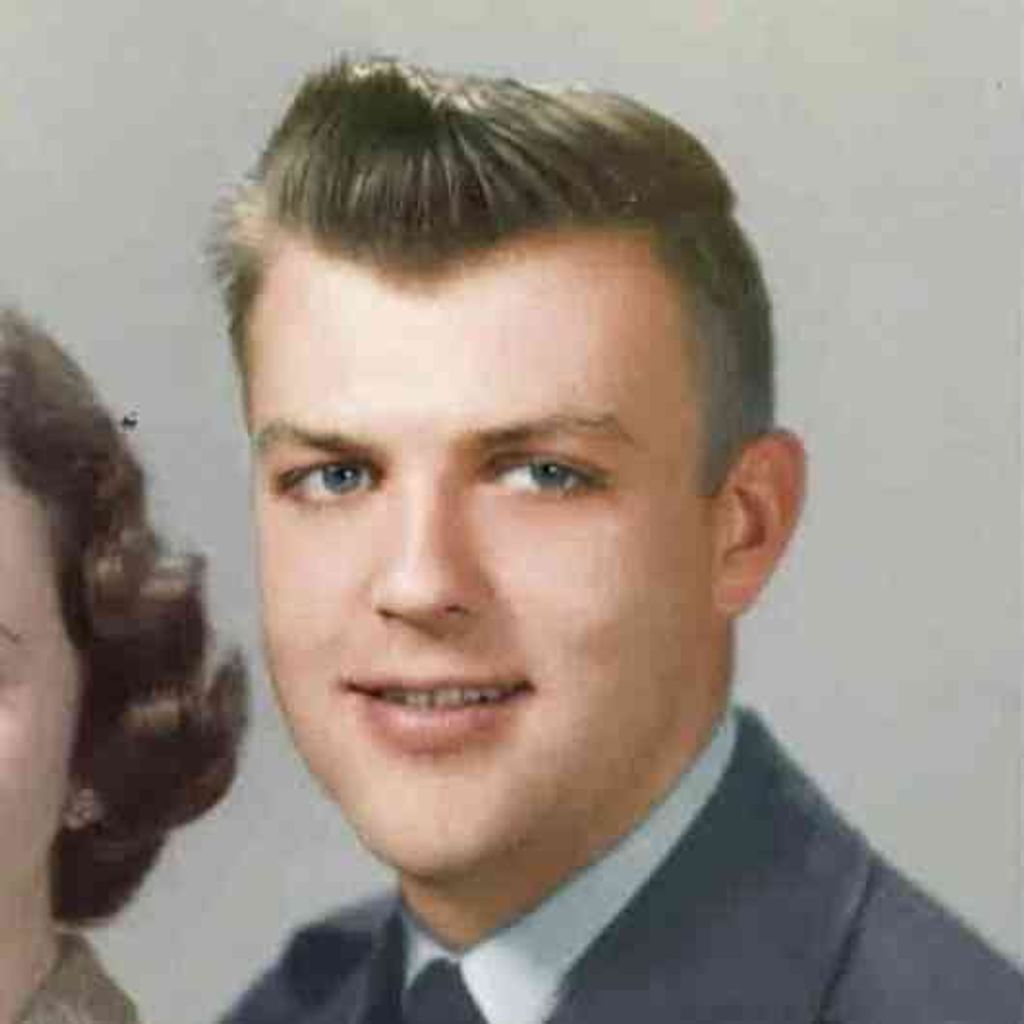
Harlan Keith Goodell
1930 - 2025
Share Harlan Keith Goodell's obituary with others.
Invite friends and family to read the obituary and add memories.
Stay updated
We'll notify you when service details or new memories are added.
You're now following this obituary
We'll email you when there are updates.
Please select what you would like included for printing:
Harlan was born on December 30, 1930, in Mankato, Minnesota, to Harvey and Helen (Brown) Goodell. He belonged to the Silent Generation and was raised in a household shaped by discipline and self-reliance in the midst of the Great Depression. His father, Harvey, was a gifted mechanic, and from him Harlan absorbed a natural understanding of machines, tools, and systems. His mother was a homemaker, and placed a strong emphasis on responsibility and high standards. When Harlan was old enough to leave home, he did so decisively, eager to build his own life.
Harlan was an unusually capable student. He surprised his principal by earning the highest aptitude score in his graduating class, despite having little interest in formal schooling. He earned his high school diploma in May of 1948 at Cloquet High School in Cloquet, Minnesota. By then, he had already decided on a military path. He greatly admired his older brother Leonard, a Navy Seabee, whose competence and ingenuity left a lasting impression and helped shape Harlan's own approach to life.
Harlan enlisted in the United States Air Force in July 1948. Early in his service, he met Mary Blair Richardson, who became the love of his life and his wife. Together they built a full life, raising three sons, Danny, Jon, and Tommy. Though he was often deployed overseas, family was central to Harlan's identity, and he shared his love of country and service with his children. All three sons later entered military service themselves, a reflection of the values he modeled rather than preached.
Harlan served in the Air Force for more than twenty years, retiring on December 1, 1968, at the rank of Master Sergeant (E-7). His career was centered in military technical and signals intelligence, placing him at the intersection of engineering, security, and emerging technology during the early Cold War. His service took him across four continents, with assignments including Japan, Australia, Indonesia, the Philippines, Alaska, and Germany, among others.
While stationed in postwar Japan in the early 1950s, Harlan worked during a pivotal moment in technological history: the transition from vacuum tubes to transistors. At the time, transistor technology was considered highly sensitive and strategically important. Its dissemination was carefully monitored by the U.S. military to ensure it remained within approved civilian and allied channels.
In this role, Harlan interacted with Japanese industrial leaders, including Masaru Ibuka and Kazuo Iwama, during their formative years. His work involved technical assessment and oversight of emerging electronics manufacturing, ensuring that advanced transistor knowledge moved from military research into civilian applications without compromising security. He understood the hardware at a fundamental level, not as abstract theory, but as something built, tested, and applied.
His expertise in transistor technology was so well regarded that he was offered a civilian position at Bell Laboratories, then the global epicenter of semiconductor research. He chose instead to remain in uniform, recommitting to military service and continuing deployments to strategic locations around the world.
Harlan was a veteran of the Korean War and the Vietnam War. During Vietnam, Harlan served as a crew member on combat support missions over hostile territory. For sustained meritorious achievement in aerial flight between January 1967 and February 1968, he was awarded the Air Medal with two Oak Leaf Clusters. These honors reflected the steady professionalism and technical competence he brought to demanding situations.
After retiring from the Air Force in December 1968, the family moved to Beaverton, Oregon and Harlan took an important technical liaison and international program management role at Tektronix, overseeing the exchange of technical knowhow between Oregon and Tokyo. Over the years he and Mary continued building their life together, seeing their family grow to include several young grandchildren. Her sudden death from a brain aneurysm in October 1979 was a devastating loss. Those close to Harlan saw a man who had spent his life solving problems confront one he could not fix. He carried on, as he always had, but the loss marked him deeply.
Upon retiring from his career with Tektronix, Harlan moved to Canon, Georgia and became a successful commercial farmer of poultry and livestock. The farm was not only his livelihood but his laboratory. Harlan rebuilt engines and farm machinery, repaired tractors and vehicles, designed systems, and solved problems with patience and precision. He dug his own water well and designed its filtration system himself. There was little he would not attempt to fix if given the chance. Farming suited him not because it was easy, but because it demanded constant attention, judgment, and humility. Weather, animals, and machinery all had their say.
He was a devoted grandfather and teacher by example. The farm was at the center of some of his grandchildren's happiest memories, a place where they were not just visitors but participants. They worked alongside him, sometimes doing hard work, sometimes laughing, always learning. He took them flying in his airplane, parked at the small airport behind the farm. He taught them how to restore an old sports car, how to fix a radio, and to understand the logic behind machines. To them the farm was a place of freedom, purpose, and adventure, and time spent there with him left a permanent mark on their lives.
In the final chapter of his life, Harlan married Shirley Ann Fields in June 1997, with whom he shared many years of companionship. Wherever Shirley played the organ, Harlan became an active member of the church community, quietly supporting her and participating fully in congregational life. After Shirley's passing in April 2025, Harlan moved to The Villages, Florida, to be closer to family.
He was direct and pragmatic, and he lived according to his convictions. He valued honesty, competence, and self-reliance, sometimes to a fault, but always with integrity. He was quick-witted, mechanically gifted, and generous with his knowledge.
Harlan was preceded in death by his father Harvey, his mother Helen, his brother Leonard, his first wife Mary, his wife Shirley, and two sons, Thomas (Geneva) and Danny Goodell. He is survived by his son Jonathan (Cindy) Goodell of Marietta, Georgia; fifteen grandchildren, fourteen great-grandchildren, seven step-grandchildren; his stepdaughter Lisa (Charlie); and stepsons Perry, Christian, and Paul Fulk (Nancy); as well as a large circle of extended family and friends who admired his strength and kindness.
He was deeply loved, and he will be greatly missed.
Family and friends are invited to a Celebration of Life service on Saturday, January 31st at 11:00 am at Aycock Funeral Home in Ft. Pierce, Florida with burial to follow at 12:00 pm at Hillcrest Memorial Gardens. A reception will be held at Aycock Funeral Home after the burial.
Harlan Keith Goodell's Guestbook
Visits: 85
This site is protected by reCAPTCHA and the
Google Privacy Policy and Terms of Service apply.
Service map data © OpenStreetMap contributors