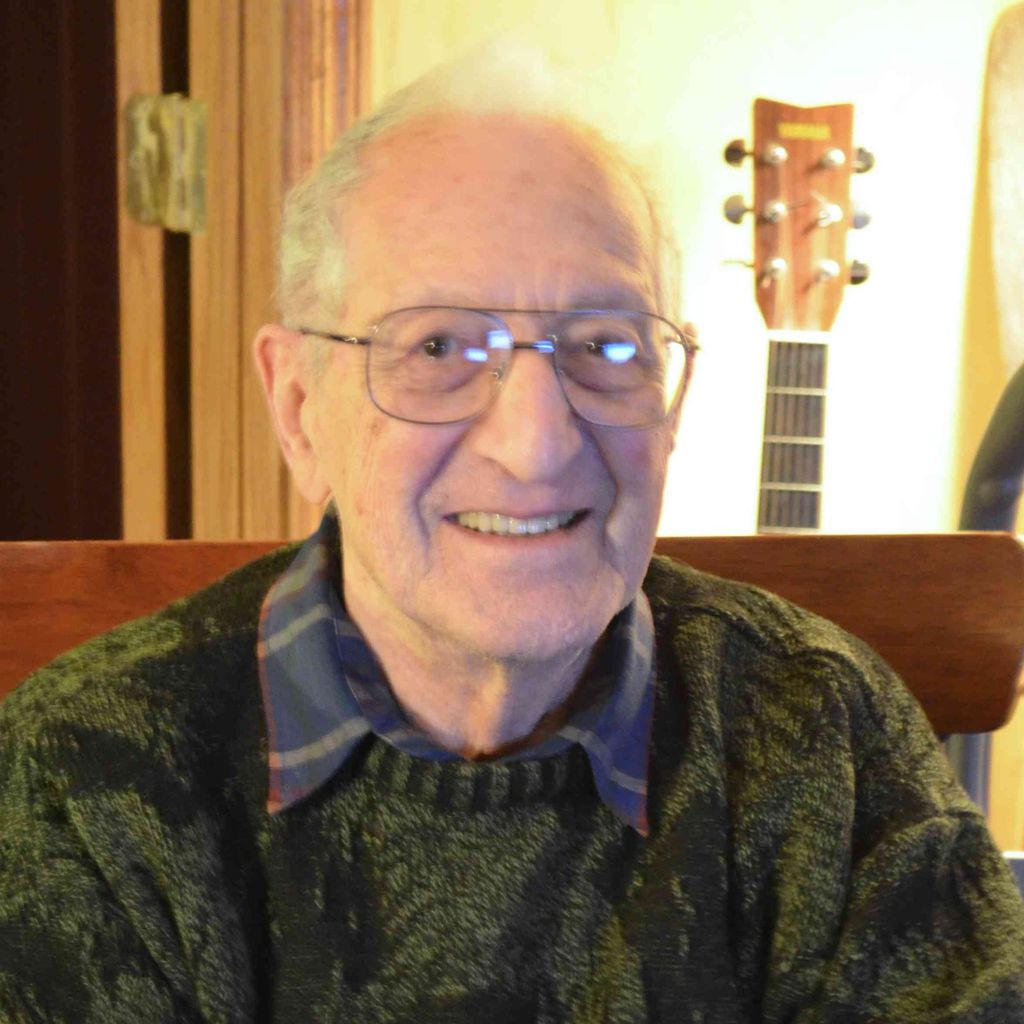
Harold Lieberman
1922 - 2026
Share Harold Lieberman's obituary with others.
Invite friends and family to read the obituary and add memories.
Stay updated
We'll notify you when service details or new memories are added.
You're now following this obituary
We'll email you when there are updates.
Please select what you would like included for printing:
Harold was born in Toledo, Ohio, on March 30, 1922, the youngest child of Jacob Ephraim and Jennie Rose (Berman) Lieberman. He had three sisters and a brother, all of whom were ten to eighteen years older than him.
Grandfather Isaac Lieberman had emigrated from Russia (Novogrudok, Belarus) with his second wife, coming first to New York City in 1890, then finally to Columbus, Ohio, six years later. Jacob, the oldest child, remained in Russia with two sisters until 1901, when they arrived in America. By 1903 Jacob had moved to Toledo and, in December of that year, he met and married Harold's mother.
Grandfather Joseph Berman also had emigrated from Russia (Panevezys, Lithuania), coming to Toledo in 1891, then sending for the family three years later. When they arrived in Konigsburg, East Prussia (now Eketerinburg) to take the boat, all they knew was they were to go to Toledo, but they didn't know where it was. Finally, a letter from Joseph mentioned that he had been to Cleveland, so they put the family on a boat to the USA, instead of Spain. (Harold said his mother never tired of telling why he spoke English rather than Spanish.)
Harold began a long educational journey at the age of four, when his mother enrolled him in kindergarten at Sherman School, the largest elementary school in Toledo. He spent the next ten years in that school. In 7th and 8th grade, he was the captain of the school's safety guards. A fringe benefit of that position was receiving concert tickets to every symphony orchestra that came to town. His exposure to nearly every major orchestra in the country resulted in a life-long musical interest.
Harold's father Jacob was a tailor and, later, co-founded a cloak-and-suit company. When Harold's oldest sister Belle got married in 1927, five-year-old Harold was the ring-bearer, the first to go down the aisle. At rehearsal, he refused to perform, but the next day, he behaved perfectly. When asked why, he replied, "Yesterday, I didn't have my full-dress suit on!" (Until his father's death, all of Harold's clothes were "tailor-made" by his father.)
Then came the 1929 Crash and the Depression. When the banks closed, his father was unable to access his accounts and, ultimately, they lost their home. By this time, all Harold's siblings had been married (or were about to be). Harold and his mother moved into a rental flat. In that long period, his father had developed stomach ulcers and, after several years, succumbed to it in 1935. His death was a shock to Harold, who had never been told how serious things were; it was years before he could talk about his father's death.
In September 1936, Harold entered Toledo's Scott High School, which turned out to be the best academic high school in Ohio. Harold was a good student among many. In the spring of 1937, he took the state test for algebra and scored first in Ohio city schools. Among his classmates, there were six others who scored first in different subjects and, once again, Scott was first in the state.
By the summer of 1938, the family could no longer support a separate household for Harold and his mother. It was decided that Harold would go to live with his middle sister Marge in Dover, Ohio, while his mother would go to live with his youngest sister Florence in Detroit. Harold had no choice in this, and he did not look forward to leaving Toledo (a great city of over 300,000) and moving to a small town of under 10,000.
How wrong he was! While he knew Toledo—and only Toledo—very well, most of the students at Dover were familiar with all the major cities in central and eastern Ohio. Although Dover High was not the academic powerhouse that Toledo Scott was, Harold soon found great opportunities for learning. He joined the new Debate Club, overcoming his fear of public speaking, and became its president. He won the job of announcing basketball players at the games. He auditioned for and joined the Drama Club. But the most pleasurable activity of all was being able to join the school's a cappella choir (as a baritone), which earned a Superior rating at the state competition in Columbus.
It was during a history class at DHS that Harold became aware of the connections between present events and the past. He didn't know it then, but this understanding became a catalyst to much of his subsequent academic life.
Living with his sister Marge and her husband Sanford (Sam) was a different experience. The Depression was still on, nobody had any money. Sam worked in his family's clothing store; he was the best salesman in town. They had one child, Bonnie, who was a very bright and talented five-year-old when Harold arrived. The bond between the two grew and lasted his whole life.
After graduating with honors from DHS, Harold went back to Toledo to live with his brother Cal's family. While working during the summer, he learned about the National Youth Administration (the work-study of its time), so he applied for admission to the University of Toledo and for NYA. But since most NYA assignments required typing skills, which he didn't have, he got a typing book from the library and practiced on Cal's typewriter. When school started, he was assigned to the office of Dean Searles, the dean of the College of Business Administration. (Harold learned later that the dean, who knew Cal, had placed Harold "where he'll learn something." The dean was right.)
Not knowing what he wanted as a major, Harold took mostly general education courses with a sprinkling of history. And he joined a local fraternity. (It was years before he figured out that he was working a total of 38 hours a week, while carrying a full academic load and extra-curricular activities, but didn't everybody in those days)?
And then, after two years of college, World War II intervened and Harold was drafted. He first was assigned to the Armed Forces Examination and Induction Center in Louisville, Kentucky. After four months, he was transferred to the headquarters of the new Ordnance Parts Clerks School in Rossford, Ohio (just outside his hometown of Toledo!). It was here that he was first called "Hal," the only nickname he'd ever liked and one that he kept for the rest of his life.
After about a year and a half at Rossford, Harold was transferred to The Ordnance School at Aberdeen Proving Grounds in Maryland, the largest school in the army. He was assigned to the Office of the Commanding General and soon became the Sergeant-Major of the office. After more than a year at APG, and with the war now over, Harold was discharged on February 2, 1946, with an Honorable Discharge from the Army of the United States.
He immediately went back to the University of Toledo to finish his undergraduate work. But now his focus had changed. He shifted from Business back to Arts & Sciences. At the end of his junior year, he received an award as the best student in A&S. He completed his B.A. in June, 1947, with a major in history and a minor in philosophy. Graduating summa cum laude, he was encouraged by the history faculty members to apply to graduate school at the University of Chicago, where he was admitted.
When Harold began at UC, Robert Maynard Hutchins was the Chancellor and the school was an exciting place. The History faculty was top-notch, and the two years he spent there were valuable indeed. His M.A. thesis on a phase of John Quincy Adams's political life led to a life-long interest in JQA and his impact on American life.
But Harold had finally figured out that he needed to learn more of the social sciences, as well as to learn how to teach at the college level. Luckily, he discovered, just as he was finishing at UC, the new Doctoral Social Science program at the Maxwell School of Citizenship and Public Affairs at Syracuse University. The only program of its kind, it was inter-disciplinary and guaranteed evaluated teaching experience at the college level! Harold was accepted, and for the next three years was a graduate teaching assistant in citizenship and sociology.
In 1951, the US Department of State selected him as the USA representative to the United Nations Summer Internship Program at UN Headquarters in New York City; with interns from 35 countries, he lived at International House. (One highlight was a picnic with Eleanor Roosevelt at her cottage north of Hyde Park.) In March 1952, Syracuse University held a mock Presidential Convention and Harold was selected as the convention chairman. In May, Harold spent two days taking his doctoral exams in five subjects.
In the summer of 1952, Harold worked for the New York State Mental Health Commission on a survey of Syracuse residents, the training for which provided lifelong interviewing skills. It was during this time that he met Mary, the woman who became the love of his life. Six weeks after they met, on August 23, they were married. With $200 in cash and a borrowed car, the couple left for Washington, DC, to seek the experience of a federal job. (Harold already had a Civil Service rating.)
The year in Washington was like an extended honeymoon. Both of them got jobs so they could eat, they found a small apartment in the home of a friendly couple, and Harold set out (with Maxwell credentials) to nail a federal job. In time, he was hired by the Department of State for a position in the area of Near Eastern, South Asian, and African Affairs. But while they waited for security clearance, President Eisenhower came in and immediately froze all but essential federal jobs. So, Harold began looking for a teaching job. (It was a wonderful year while it lasted.)
Harold was hired at Ohio Northern University in Ada, Ohio, as Assistant Professor to teach sociology courses and to design and teach the required freshman social science course. He taught for three years at ONU and used the opportunity to design a dissertation topic that utilized ONU graduates: Characteristics and Citizenship Activities of Graduates of ONU.
In September 1956, Harold was hired by St. Cloud State Teachers College in Minnesota (they dropped the name "Teachers" the next year) as Associate Professor, again to teach sociology and to re-design the required freshman social science course. Thus began a thirty-year career at St. Cloud State University. In time, he became chairman of a new social science department, which grew from two to seventeen members, becoming a department of interdisciplinary studies. He served as its chairman for seventeen years.
When the Faculty Senate was organized, Harold was elected as a member every year. He co-taught the first television course, organized the first overseas student tour, and taught the first elder-hostel course. When the Tri-College Program (with the College of St. Benedict and St. John's University) was developed, he served as SCSU's director for four years. He was selected as the first SPAN (Student Project for Amity among Nations) director from SCSU, taking students from eight Minnesota colleges to Scotland. On a sabbatical, he enrolled in Nuffield College of the University of Oxford. On a summer grant, he spent seven weeks in Latin America studying housing development. When collective bargaining arrived, Harold served as the second contract negotiator. For a year, he served as the director of St. Cloud State's Center for British Studies in Alnwick Castle, Northumberland, England. (His wife Mary served as food director.)
Harold and Mary were among the founders of the St. Cloud Unitarian Universalist Fellowship. Harold was a parliamentarian and served at a number of local and regional DFL conventions. He was a board member of the Minnesota Consumers League for several years. Mary had founded and managed Folly Farm Riding Center for a number of years; then she went back to school, completing a Master's Degree in Psychology, with a specialty in Chemical Dependency.
Upon Harold's retirement in 1985, he and Mary spent time traveling, visiting all fifty states and almost all of the Canadian provinces, as well as internationally. Their travel foci were Eastman Johnson paintings (he was Mary's cousin), genealogy, lighthouses, and Cogswell Family Association annual conventions; Hal was the keynote speaker at two CFA reunions.
Harold was preceded in death by his wife, Mary; two sons, David and Ross; a granddaughter, Maura; and many horses. He is survived by three children: Kim, Brock and Mardi; four grandchildren, and five great-grandchildren.
The obituary for Harold's wife, Mary B. Lieberman is at: https://www.legacy.com/us/obituaries/name/mary-lieberman-obituary?id=54942533#obituary
Harold Lieberman's Guestbook
Visits: 167
This site is protected by reCAPTCHA and the
Google Privacy Policy and Terms of Service apply.
Service map data © OpenStreetMap contributors