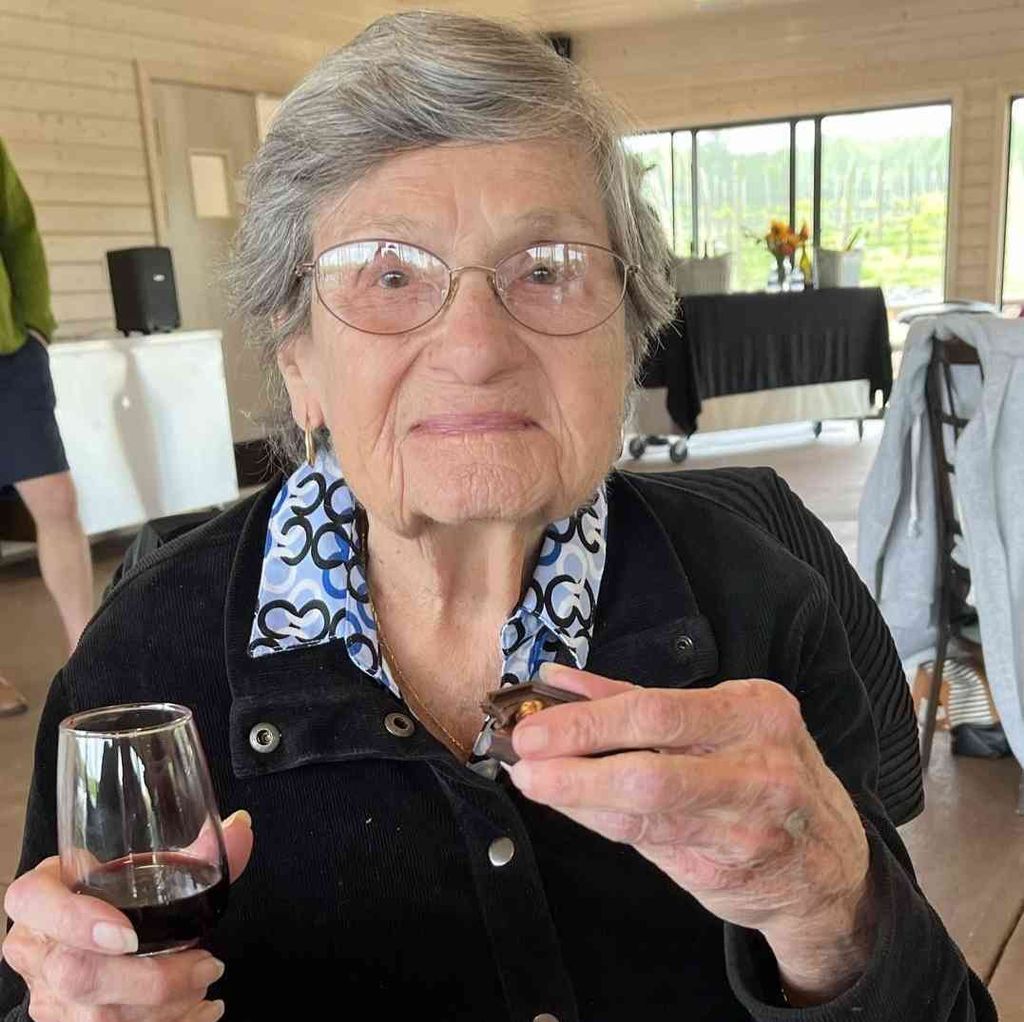
Jacqueline Lavinia Marie Liedel
1931 - 2026
Share Jacqueline Lavinia Marie Liedel's obituary with others.
Invite friends and family to read the obituary and add memories.
Stay updated
We'll notify you when service details or new memories are added.
You're now following this obituary
We'll email you when there are updates.
Please select what you would like included for printing:
Before she became the matriarch of a vast family, Jacqueline was a little girl growing up on the island of Java in what was then the Dutch East Indies. Her father, Julianus Siebelink, worked for the Dutch East Indies Railroad Company, overseeing printing operations. Her mother, Olive, was English, and together they raised their only daughter in a household that reflected the multicultural world of colonial Java.
One of her grandchildren recalled, “I remember Grandma always talked about how amazing her early childhood was. She loved living in Java, and she even had a pet monkey named Jemima.” Jacqueline described her childhood home as, “large and airy, filled with antiques” and a lively rhythm of daily life. It was a childhood of warmth, sunlight, and possibility.
All of that changed in February 1942 when the Japanese invaded the Dutch East Indies during World War II. Her father was drafted into the Dutch Army, and overnight, her comfortable, carefree childhood disappeared. Jacqueline and her mother tried to avoid capture by hiding in cemeteries.
Unfortunately, like thousands of others on Java, Jacqueline, at eleven years old, along with her mother, was captured and forced into Lampasari Camp, a Japanese prison camp in Semarang. The conditions were brutal. Jacqueline and her mother slept in a space barely four feet by eight feet along a walkway, their bed made from footlockers and boards. The camp housed thousands of women and children within a neighborhood surrounded by a bamboo fence topped with barbed wire.
Food was scarce and often barely edible. For years, the prisoners survived largely on thin starch and cabbage soup. Hunger became a constant companion. Jacqueline later recalled discovering that snails were rich in protein after a camp doctor told her they contained albumin like eggs. Jacqueline collected snails and cooked them over candle flame to share with her mother to stave off starvation.
She suffered through malaria, yellow jaundice, and beriberi.
Yet even in those darkest conditions, Jacqueline remembered resilience and defiance. The women in the camp found ways to maintain their spirit. During daily roll calls, when prisoners were forced to count in Japanese, they sometimes substituted insults for the numbers — a quiet act of rebellion that strengthened morale and reminded them they had not been broken.
For three and a half years, this was life. But, through it all, Jacqueline and her mother held onto a small promise of hope. They saved one can of sauerkraut and one can of meatballs, hidden away for what they called their “Victory Dinner.” They refused to eat them until the war was over.
In September 1945, Allied aircraft finally appeared overhead. When liberation came, the women in the camp stamped through the Japanese garden that had taunted them during their captivity, celebrating the end of years of starvation and imprisonment.
And Jacqueline and her mother finally shared their long-saved victory dinner.
After the war, Jacqueline and her mother were evacuated through Saigon and eventually sailed aboard the ship Orontes to Southampton, England. Jacqueline was fourteen years old and weighed barely sixty-five pounds.
It would be years before life fully stabilized again.
A year after the war ended, Jacqueline and her mother reunited with her father, Julianus, who had survived Japanese imprisonment but needed significant time to recover before joining his family in Kent, England. The family then moved to Holland, where Jacqueline met her Dutch relatives and saw snow for the first time. Later, they returned to England to prepare for immigration to the United States, and Jacqueline, with her cousin John’s help, improved her English for the citizenship test. Before settling in America, they briefly lived in the Panama Canal Zone, where Julianus’s family had arranged jobs and housing. From there, they moved to New York and became naturalized U.S. citizens — a milestone Jacqueline cherished deeply, never taking her freedom or opportunities for granted.
She often said that Americans had liberated her world — and she never forgot it.
In the United States, Jacqueline built a life defined by determination and independence, and that same resilience and defiance she earned during her time in the camp. She married twice, raising five children through both hardship and perseverance. She worked outside the home at a time when that was far less common for women, eventually establishing a long career as a loan officer at Columbia Federal.
To many who knew her — including her granddaughters — Jacqueline represented the first example of a woman with a career, a briefcase, a proper toolbox, and a life beyond traditional expectations. She modeled resilience, sophistication, and determination in a way that quietly influenced the generations that followed.
But her life was never defined by work alone.
Jacqueline was curious about the world. She read widely — history, science, religion, and art. She loved maps and travel. She loved music and musicals, introducing her children and grandchildren to everything from Motown to opera. She sang often, even late in life when memory had faded but music remained. And, she was known for spontaneously dancing when she heard a song she knew and loved.
Jacqueline was warm and generous. Friends and strangers alike often found a place at her table. Over the years, she welcomed people into her home who needed help, a meal, or simply a safe place to stay.
She raised her children with discipline and fierce love, teaching them independence, responsibility, and compassion.
And she loved her family deeply. She was ‘the adventurous grandma,’ who taught her grandchildren how to navigate the Washington, DC Metro system, and took them to DC to the zoo and museums. She loved being a grandma. She attended countless school plays, birthday parties, and sporting events. She delighted in sharing experiences with her grandchildren and hosted an annual proper English Tea every year at Christmas. And, just like her own multicultural upbringing, taught her grandchildren Christmas carols in English and Dutch, shared Dutch nursery songs, and the best Dutch and English candies and cookies.
Her stories of Java and of survival shaped how her family understands courage and tenacity. She passed along powerful lessons of resilience and grace, and that a woman could build a life of strength and independence on her own.
Her life was not always easy. She endured hardships, war, loss, and difficult seasons within her family. Yet she remained fiercely self-reliant and deeply faithful, carrying her Christian beliefs with her throughout her life. Even in her final years, as memory faded, her faith remained strong.
On Sunday, March 1, 2026, at nearly 95 years old, Jacqueline passed away peacefully in her sleep.
She leaves behind a vast family that carries her story forward: five children, Juliana (d. 2014), Mel, Camille, Robin, and Hayley; seventeen grandchildren and many great grandchildren and great-great grandchildren.
Her life stretched across continents and generations — from colonial Java to a wartime prison camp, from England to Holland to Panama, and finally to the United States.
She survived war, built a life from nothing, raised a family, and left behind a legacy of courage and independence that will continue long after her passing.
Jacqueline Lavinia Liedel was a survivor, a mother, a grandmother, and a woman of remarkable resilience.
And for those who knew her best, she was proof that even the most difficult beginnings can lead to a life of grace, strength, and enduring love.
Jacqueline Lavinia Marie Liedel's Guestbook
Visits: 13
This site is protected by reCAPTCHA and the
Google Privacy Policy and Terms of Service apply.
Service map data © OpenStreetMap contributors