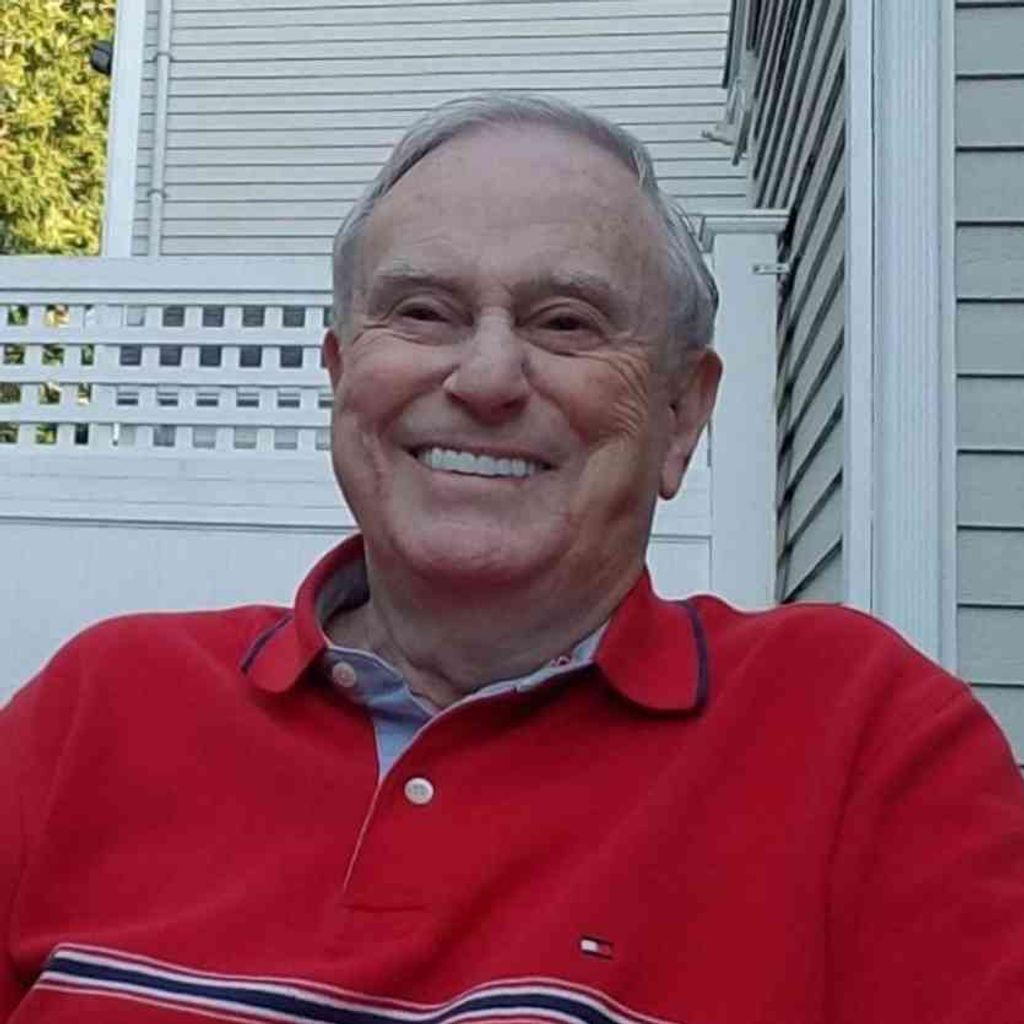
John Terrance Hart
1943 - 2025
Share John Terrance Hart's obituary with others.
Invite friends and family to read the obituary and add memories.
Stay updated
We'll notify you when service details or new memories are added.
You're now following this obituary
We'll email you when there are updates.
Please select what you would like included for printing:
After college, John joined HP in Waltham to eventually became the R&D Manager and developed cutting edge Ultrasound and MRI systems. During his time there he met the late Andrea Holland, whom he later married. They lived in Acton and later North Andover.
John leaves behind his son Jason of Athol and his daughter Kristen of Bradford and two grandchildren Jayden and Keenan as well as his younger brother Michael who followed in his footsteps nearly his entire life. John had also remained very close to his late sister Mary Hart Gwozdz of Lenox MA.
John's closest friends included his golfing friends, his many of his Hewlett Package colleagues and very close friend Stan Gold the stories from which John relished. Later in life, he developed a wonderful relationship with Karon Shea of Worcester. They would meet weekly for dinner and friendship, but also talked nightly about life, and especially his own children and grandchildren. He did the same in his weekly meetings for years with Michael.
As a father, Jason said he never met anyone with more patience, making sure both he and Kristen were doing the best they could and he was always coming up with ideas on how to make their lives better. He kept encouraging them to excel and remain curious about the world. One of Jason's favorite memories is when his dad brought home an Apple Mac in the early 80s so Jason could investigate what the "Personal Computer thing" was all about. John taught Jason how to "doodle" on it and Jason was hooked. Jason would take it apart, try to reassemble it after which John would find where the extra parts should go.
Following in his footsteps, both his brother Michael and granddaughter Jayden attended WPI as well. Just as John excelled with math and physics at WPI so did his brother. When asked, John's father told a neighbor "Mickey blows them up and Johnny fixes them" (John as the MRI guy and Mickey as the Patriot Missile Technical Director). John taught Michael how to play shortstop, throw a perfect spiral (John was QB on the WPI football team), how to golf and most of all how to think.
John has left a void far and wide. He will be deeply missed. He planted the seed of caring and compassion, that has grown into what has become his legacy, and will live on forever in our hearts and minds.
Excerpt from John Hart's HP Career from a WPI Class Newsletter
35 Years Working for a Great Company
One of my most influential professors at WPI (Bill Grogan), helped me a lot and put me in touch with a company that I never heard of, Hewlett Packard (HP). At that time, it was only a $100M company. I joined at just the right time for an engineer. The company was dedicated to R&D innovation with an unusually supportive culture created by the founders.
Since HP was an R&D company and because those were the days of engineering shortage, HP offered to pay my full salary while sending me to MIT for a couple years to obtain an EE Master's Degree, an offer I couldn't refuse.😊.
It was also my great fortune to meet my wife Andrea at the company, and have two great kids, Kristen and Jason. Andrea's first passion was our kids, but she was also a gifted artist who met her goal of obtaining a fine arts degree summa cum laude at the same time. Unfortunately, she passed in 2016.
I joined HP in 1965 when it was rapidly becoming known as an innovative technology company. HP allowed me to work with some top Academic Medical Centers and to develop personal relationships with gifted doctors and professors to aid in developing leading edge solutions for millions of patients.
HP was good for both employees and customers, attributable to its founders Bill Hewlett and Dave Packard. They often reminded analysts that "HP is an R&D company focused on the long term. For short term thinking, there are plenty of other stocks to choose from." HP and IBM swapped titles as the "Best place to work" for quite a number of years.
Bill Hewlett's father had been a doctor at the University of Michigan, and Bill wanted to contribute to patient care. Thus, in 1961 HP acquired Sanborn Company, a company in the EKG and Patient Monitoring businesses and as the business grew, the divisions were created, spread internationally and renamed the Medical Products Group
By 1980, both the EKG and Patient Monitoring businesses had grown significantly to become number one in their respective markets, then mainly hospitals. HP Medical Products Group became known as an innovative technology company.
I spent time as the Patient Monitoring system manager. As the businesses started to mature, I was asked to evaluate the potential for entry into the Diagnostic Ultrasound Imaging market and later to adapt/develop new imaging technologies for the Cardiology market. It 1980 the products made it to market; it took 4 about years of R&D to develop what was regarded the best products in the world and by then I had become the R&D manager for the division. Hewlett and Packard invested heavily in this, and it paid off.
Systems revenue grew to a 75% market share of cardiac Ultrasound in the US, and it became the technology and market leader in the rest of the world. HP's Ultrasound business had become a division with about 2000 employees for which I felt especially proud.
In 1989 I became the R&D Group manager for HP's Medical Group, about 400 engineers, followed by General Manager of an MRI business while I managed a partnership with Philips Electronics in the Netherlands. The unstated goal of which was for HP to buy Philips if the partnership worked.
HP then afforded me an opportunity to attend Harvard's Executive "International Advanced Management Program." It was an on-campus program for three months. Mostly International CEOs and Executives were enrolled. It was one of the best time periods of my career, working on a personal basis with highly placed government officials from all over the world and International top-level management. This stint served as preparation for my next role in 1996, heading a group of senior managers to develop HP's Corporate strategy and structure.
In 1999 HP announced the split-up into two companies: one retained the HP name, a computer/printer company, and the second was Agilent, a company making and selling measurement equipment, as in the businesses of the Medical Products Group.
My New Role
I was asked to form a group of experienced managers and propose HP's future strategy, and the restructuring of the company to achieve it. (Who? Me?)
My group of managers were from HP's Pharmaceutical Measurement Group and its Medical Group, the only two businesses that had their own sales forces. The long-term computer solutions for these businesses would impact the HP strategy and organization.
The conclusion was that it was time for HP's customer companies and corporations to begin integrating department computer solutions into one overall network (via what was later called "The Intranet") rather than continuing to use separate networks optimized for each department.
What would that mean for HP's organization? This strategy would require HP to buy a management consulting division from one of the "big six" accounting firms who served the CEO-suite (KPMG, Price Waterhouse, Ernst and Young, etc.), in order to obtain the several thousand employees that could work with both the CEO suite on company strategy and with the IT departments on integration.
HP's Board chose to use that as their future strategy and restructuring.
Prophetically, when I attended Harvard earlier there was a case study on HP. It concluded that founders could sometimes keep their own culture until they left, then the company would likely then be turned over to "professional" management, becoming just like any other company. I thought to myself, "I hope that doesn't happen to HP", but unfortunately the HP founders passed and with-it HP's culture; a culture Hewlett and Packard created which lasted for 60 years. The "Professional" management team took over and HP lost both its culture and its direction.
I was indeed lucky to have worked for the founders within the HP culture.
Celebration of Life and Donations
Details on The Celebration of John's Life will be forthcoming soon
In lieu of flowers, If anyone would like to donate a tree in his memory, the family requests donations via https://shop.arborday.org/commemorative-trees-for-others
John Terrance Hart's Guestbook
Visits: 28
This site is protected by reCAPTCHA and the
Google Privacy Policy and Terms of Service apply.
Service map data © OpenStreetMap contributors