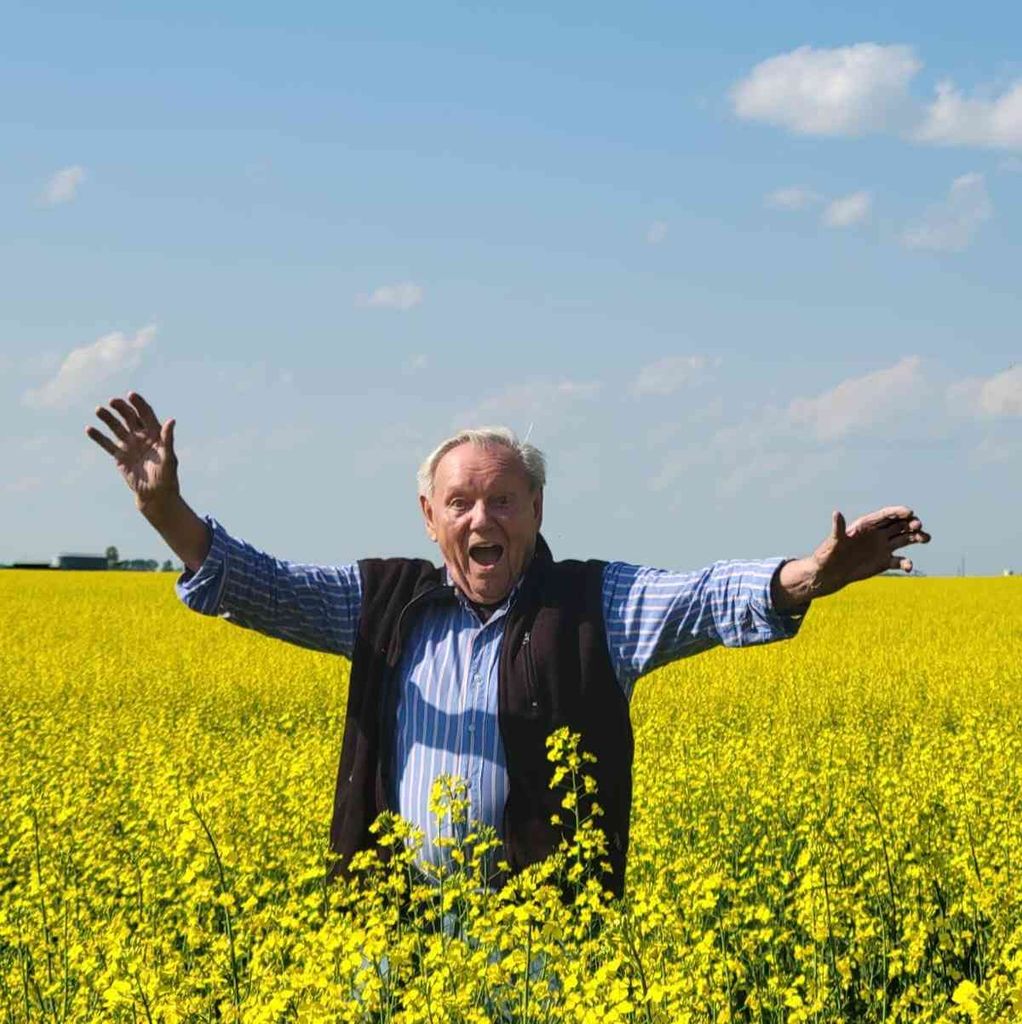
Orland Martin Francis Larson
1931 - 2026
Share Orland Martin Francis Larson's obituary with others.
Invite friends and family to read the obituary and add memories.
Stay updated
We'll notify you when service details or new memories are added.
You're now following this obituary
We'll email you when there are updates.
Please select what you would like included for printing:
Born in the southwest corner of Saskatchewan on March 6, 1931, Orland was the second of four sons of Leonard Larson and Miranda Irene Engdahl. The early loss of his mother in 1945, just before her fortieth birthday, shaped him profoundly. He carried her memory with him throughout his life and later named the Leonard Miranda ARTISAN Foundation of Canada, his long-running fundraising initiative, in honour of both his parents.
His belief that every child is uniquely creative began in 1951 at Saskatoon Teachers’ College under the mentorship of Wynona “Nonie” Mulcaster. That conviction guided more than sixty years of teaching. Early in his career, he worked in northern Canada within the federal school system. In the mid-1960s he served as a school principal in Qikiqtarjuaq, then known as Broughton Island, administering the local day school that also boarded children from surrounding camps and bringing art and education to communities in the eastern Arctic.
A top BSc graduate in Arts Education, summa cum laude, at the University of Wisconsin in 1958, he went on to complete advanced graduate studies supported by scholarships, fellowships, and Canada Council grants. He pursued metal studies under renowned American goldsmith Stanley Lechtzin at Temple University and conducted doctoral work at Columbia University in New York.
Before finishing his final degree, he initiated the first professional jewellery program in Eastern Canada at NSCAD University in Halifax, where he taught for almost a decade. He later revitalized the jewellery department at the Alberta College of Art in Calgary in the early 1980s. Students were drawn to his rigor and his ability to see potential in others. He trained their minds and their eyes, helping them recognize beauty and translate it into their own creative work.
Over his career, Orland delivered more than 300 workshops and lectures across Canada and internationally, including in the United States, Brazil, Puerto Rico, Thailand, Cambodia, and throughout the Canadian Arctic. He described his work as “helping others so they can help someone else,” a philosophy that guided both his teaching and humanitarian initiatives.
His leadership within the craft sector was extensive. He served as President of the Nova Scotia Craft Council, President of the Alberta Craft Council, President of the Canadian Craft Council, Vice President and founding member of the Society of North American Goldsmiths, and President of the North American Region of the World Craft Council. He helped establish the Saidye Bronfman Award, organized and juried ARTISAN ’78, Canada’s first national craft exhibition, and curated the first Inuit Jewellery Exhibition. He was the first Canadian goldsmith to register his hallmark at Goldsmiths’ Hall in London, England.
Beyond the classroom and the studio, Orland was an exceptional host and enthusiastic cook. At his property in Nova Scotia, he welcomed friends, students, and colleagues from around the world, delighting them with carefully prepared meals, lively conversation, and long evenings that blended food, conversation and ideas. Hospitality was, for him, another form of connection and creativity.
In retirement, he divided his time between Canada and Thailand, embracing travel and continued projects with characteristic intensity. Even into his nineties he would declare, “I refuse to stop,” fuelled by lists and new initiatives.
Orland had a lifelong fascination with patterns and symbolism. Born on March 6, he delighted in noting that three and six add to nine, a number he associated with accomplishment. He embraced his identity as a Pisces and believed life unfolded in meaningful cycles.
In his later years, he became a passionate advocate for reclaiming the word ARTISAN, arguing that language shaped how creative work was valued. For him, an artisan created unique objects of clay, fibre, metal, wood, leather, or paper with intention, discipline, and responsibility.
Beyond his public accomplishments, Orland was independent, exacting, generous, and loyal. He was a disciplined walker who took regular two kilometre walks well into his nineties. Living only blocks from the downtown library, he remained an avid reader. Rarely without a camera since the age of twelve, he documented the world around him as long as he could as both witness and inspiration.
In his later years, even as his world grew smaller, he remained deeply himself, appreciative of the beauty of nature, all things sweet, tasty curries, good oatmeal with milk and, as he preferred, lots of brown sugar, a properly cold gin and tonic, and the quiet integrity of well-made things.
He often reflected that he had lived a long and useful life and did not think negatively of death. For him, life had been an unfolding series of projects marked by completion, accomplishment, and growth.
He is survived by his daughters Annelise and Jennifer, sons in law Chris and Jim, his younger brother Dale, his grandchildren Mira and Rowan, his dear companion and friend in Thailand, Sakchai Vichayapak, his Cambodian students and "sons" Suon Nhim and Vanna Norm, extended family, former students, colleagues, and friends across Canada and around the world.
A gathering to celebrate Orland’s life will be announced at a later date. Those who wish to honour him in the meantime are invited to share stories and photographs here.
In lieu of flowers, donations may be made to a craft organization of your choice or in support of emerging artisans in your community.
Orland Martin Francis Larson's Guestbook
Visits: 423
This site is protected by reCAPTCHA and the
Google Privacy Policy and Terms of Service apply.
Service map data © OpenStreetMap contributors