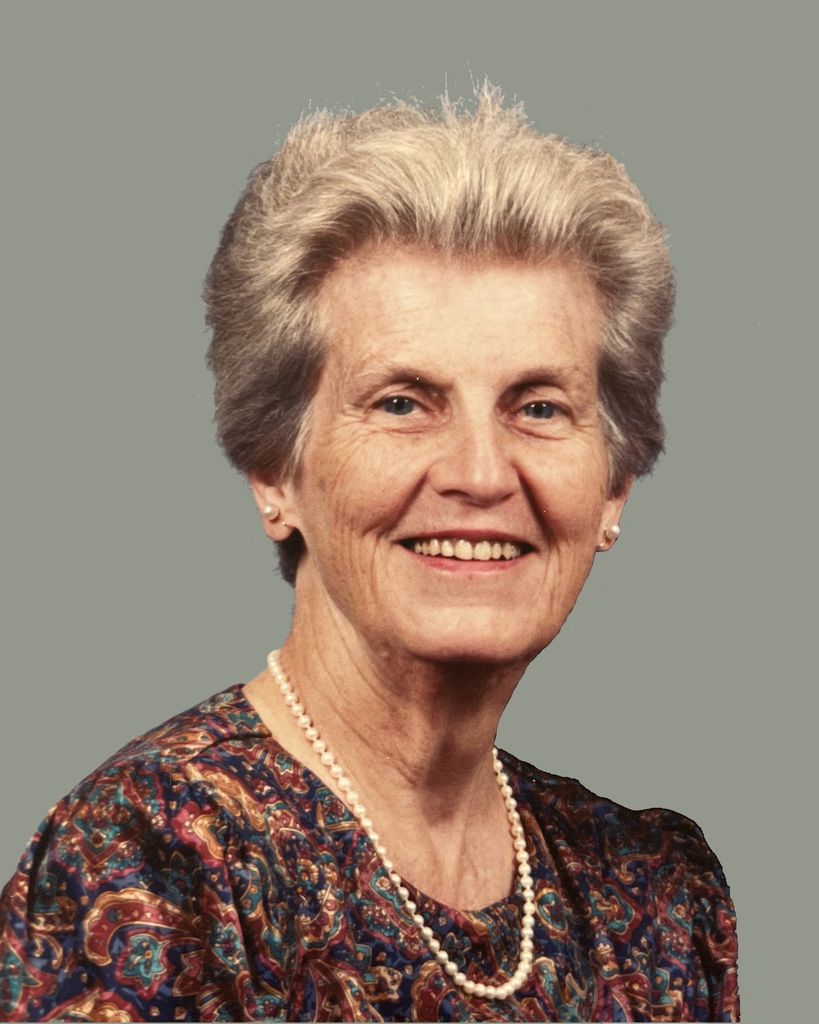
Rosemary Scala
1928 - 2026
Share Rosemary Scala's obituary with others.
Invite friends and family to read the obituary and add memories.
Stay updated
We'll notify you when service details or new memories are added.
You're now following this obituary
We'll email you when there are updates.
Please select what you would like included for printing:
When Rosemary Durnan finished high school in 1945, her parents insisted she attend one of the Catholic universities close to home in Boston. The only way they would let her go somewhere else was if she wanted to study something those schools didn’t offer. Rosemary was a devout Catholic and had just graduated from a Catholic high school, but she wanted a different experience. She enrolled at the Massachusetts Institute of Technology and majored in chemical engineering. Such independence of mind, backed by a New Englander’s pragmatism and grit, came to characterize her life.
Rosemary was born on June 11, 1928, in Boston, Massachusetts, to Rose Marie (Hickey) and Walter Durnan, both of whom were from proudly Irish families. Her sister Ruth and her brother Vincent followed two and five years later. Growing up, Rosemary insisted on being called by her full first name, no nicknames allowed to anyone – except her dad, who sometimes called her Roma.
She was a quietly confident child raised in an intellectually stimulating and physically engaging environment. She liked playing with blocks more than dolls and came to love the logic of math and the power of Shakespearean plays. Her life would be marked by a yearning for knowledge and experience, her raw curiosity channeled by her upbringing and her faith.
When Rosemary was a baby, the family lived in Dorchester but soon moved to Brookline. She attended the Edith Clark Baker Elementary School, where many of her classmates were Jewish refugees from Europe. Around the time she started high school, the family moved to an older, larger house in West Roxbury that featured built-in furniture and stained glass.
In the early years, daily deliveries included the newspaper, milk and ice. The family’s ice box consisted of three compartments: one to hold ice, another to keep things cool and a third to keep things frozen. In those days, the butter and egg man came by regularly, the rag man made his rounds on a horse-drawn cart and, in the winter, horse-drawn snowplows cleared the sidewalks.
Rosemary’s mother was a teacher who had to set her career aside when she got married. She was able to return to the classroom later, working at a juvenile detention center and at the Young Men's Hebrew Association and Young Women's Hebrew Association. Rosemary’s father worked in Boston’s public school system, first as a teacher and then as the headmaster of Boston Technical High School. The advantages offered by that position included both a regular salary, which helped the family weather the Great Depression, and summers off – which meant the family could spend several months at Cape Cod every year.
“The Cape” was central to Rosemary’s childhood. She had a posse of friends there and kept busy swimming, playing croquet and putting on plays. But those epic summers on the beach came to an end in 1939. Rosemary remembers crowding into the car with her family to listen to the news on the radio about the outbreak of the Second World War. Two years later, the family learned about Pearl Harbor on the radio too, while gathered in the family library.
Rosemary was an avid reader and particularly fond of travel and adventure books. To prepare for her own life of exploits, she joined the Brownies when she was little and advanced to the Girl Scouts in high school. She learned how to sail as part of the community sailing association; sailboat races took place in the Charles River Basin, not far from MIT. She also enjoyed cross-country skiing. Rosemary’s first airplane ride, in a small craft that flew out of a local airport, came when she was 12. It was also around that time that she embarked on an initial solo trek – a train ride from Boston to New York to stay with family friends.
An interest in foreign locales was nourished by Rosemary’s early exposure to Rome, which came by way of her Uncle Augustine Francis Hickey (“Padre”) and her Uncle Vincent Hickey. Both men went to seminary in the Eternal City and were ordained there. Incidentally, one of the only dolls that she liked to play with as a child was an Italian peasant Lenci doll that Padre or Uncle Vincent brought back for her. Italy would come to play an important part in her life.
Rosemary excelled at Notre Dame Academy, a private all-girls high school. Those years coincided with the Second World War, and she did her part on the home front: she made rosaries for soldiers and volunteered at the blood donor center alongside her mother. She held summer jobs, and she got around the city on her own by taking the T (Boston's subway system). Her only contact with boys during that period came during her monthly outing to Miss Burns Dancing School.
After graduating from high school in 1945, Rosemary enrolled at MIT. It was in nearby Cambridge, which meant she could live at home. A shy, serious and studious young adult, she finished college in three years, graduating with a bachelor’s degree in chemical engineering on June 11, 1948 – her 20th birthday. That was the same year she first saw TV.
It took Rosemary some time to find a job in her field, as the choice positions went to war veterans. After a few months she was hired by a private laboratory, Dewey and Almy.
1949 turned out to be a watershed year for Rosemary: that’s when she became acquainted with an Italian chemistry student named Luciano Scala. He was at MIT as part of a summer project for foreign students, and she was involved in the organization that sponsored visiting foreign students. Luciano had to go back to Bologna at the end of that summer but returned to MIT in February 1950 on a Fulbright fellowship. Rosemary and Luciano crossed paths at the university’s Catholic club (whose president, Paul Johnson, later married Rosemary’s sister), and they saw more of each other as the year progressed.
In August 1950, Luciano wrote this about Rosemary in a letter to his brother back in Bologna:
“And now for the big news: are you sitting down? It seems I'm getting married...What do you think? I met this girl a while back, a year ago to be precise, but I only started seeing her a lot this year. Her name is Rosemary Durnan and she's a wonderful girl, Irish background; she's 22 years old, she graduated from MIT in chemistry, and she's currently working for a company. A girl like her, very pretty, well-educated, a career…I'm head over heels!”
Rosemary and Luciano married on January 6, 1951, at St. Theresa’s church in West Roxbury.
Luciano was welcomed into Rosemary’s family, who appreciated his gregariousness and culture. Unfortunately, she never met Luciano’s parents: Antonio and Ines were unable to make the transatlantic trip for the wedding, but they were thrilled that their older son had found the love of his life. Antonio had an engagement ring made for Rosemary in Rome, and, as a wedding gift, Ines sent Rosemary an Italian cookbook marked with Luciano’s favorite recipes – Rosemary thought that was wonderful. When Rosemary eventually made it to Italy in 1972, Luciano’s younger brother Claudio, along with his wife Liliana and their two daughters Simonetta and Francesca, gave Rosemary the warm reception that would have met with Ines and Antonio’s approval.
Rosemary quit her job soon after the wedding and gave birth to her first child, Peter, in October 1951. In 1952, the little family moved to New Haven, Connecticut, where Luciano found his first post-MIT position. Child number two, Claudia, was born in April 1953.
In 1953, Luciano was hired by Westinghouse, and the family relocated to Pittsburgh. Rosemary had two more children in quick succession: Mark in 1954 and Robert in 1956. Their last big move was to Murrysville, an eastern suburb of Pittsburgh populated by numerous Westinghouse employees, where Rosemary and Luciano built a house. Rosemary regretted leaving the city, with its many conveniences and opportunities, but soon adapted to Murrysville, which would be her home for the following seven decades.
In Murrysville, Rosemary and Luciano rounded out the family with Francesca, born in 1962, Nina, 1966, and Christopher, 1969.
Soon after she and Luciano married, Rosemary's vision started to decline and within a few years she was deemed legally blind. This created unexpected challenges with raising a growing family, but Rosemary never let it slow her down.
Common wisdom has it that the loss of one of our senses renders the others more acute. Such was the case with Rosemary and her vision problem: her children were quickly disabused of any notion that they could take advantage of it. According to family lore, she could always tell when the boys’ hair was too long or the girls’ skirts too short.
Rosemary’s eyesight did weigh on her professional prospects, however, as did her suburban exile and the needs of a large family. Undaunted, she found ways of channeling her considerable energies. One was volunteering. An early foray in that direction was in late 1960 with Bookmobile, where she began by checking out books for students and then took responsibility for scheduling the volunteers. She helped administer the adult school classes at the local high school for many years; this meant finding subjects and teachers, coordinating student reservations and processing payments. She also taught Sunday school at Mother of Sorrows Church for several years. Later, with Luciano, she got involved with Meals-On-Wheels, scheduling drivers and helping deliver meals. In addition, she was active at one time or another in the Pittsburgh Council for International Visitors, the local Republican Committee and Pittsburgh Symphony East.
To help her meet her extensive commitments within the community, Rosemary could draw on a network of friends happy to drive her wherever she needed to go. The advent of personal computers was another boon: once she acquired screen-reading software, she set pen and typewriter aside and mastered word processing.
Rosemary’s involvement in the community extended to social gatherings. She and Luciano took turns with other couples hosting bridge evenings and dinner parties for many years. Those events were an opportunity for Rosemary to teach her children some important life skills: they learned how to polish silverware, shuffle cards and pilfer tasty food.
As the younger children came up, the older children started moving out and going to college. But until the 1980s, Rosemary had a sizable family to feed, day after day, year in and year out. She and Luciano agreed on a weekly food budget, which Rosemary managed carefully but not at the expense of culinary enjoyment. She even treated her children to the occasional exotic delicacy such as liver, squid and calf’s brain. Her multi-course meals at every Thanksgiving and Christmas celebration for the ever-growing Scala contingent – children, significant others and grandchildren – were legendary.
Of course, the nourishment at the dinner table wasn’t only physical: Rosemary and Luciano would engage the kids in intellectually stimulating discussions and quiz them on various topics, including math, spelling, history and language.
Out of necessity, Rosemary made nearly everything from scratch, stretching a dollar to last a month. She roasted and ground her own coffee and made yogurt, granola, mozzarella, pesto and fresh pasta. She baked bread – sourdough, pumpernickel and pita – and made her own pizza dough. She cooked recipes from Luciano’s youth in Italy, including artichokes, both fried and alla Romana.
To ensure there was wine at every dinner, Rosemary learned the intricacies of winemaking. Luciano supported this initiative, even going so far as to buy her a wine press. When it became clear that the vines that she planted beside the vegetable garden behind the house would never produce a sufficient yield, Rosemary and Luciano began what would become an annual fall pilgrimage to Erie to buy grape juice.
Rosemary never lost her connection with the outdoors. She got back into sailing when the family joined the Pymatuning Yacht Club in northwestern Pennsylvania in 1967; for over 20 years, she and Luciano (and whichever kids were around) would spend summer weekends at the lake. She also resumed cross-country skiing in the winter: the couple spent numerous Saturdays exploring the trails in Laurel Ridge State Park near Ligonier. Some winter days, when the lure of the snow got the better of her, Rosemary was known to strap on the skis and glide around the family’s small yard in Murrysville. She would also go on short skiing, hiking and whitewater rafting trips with friends. In the summer, she enjoyed swimming laps outdoors at the Murrysville Swim Club; she would swim a mile, slow and steady.
Always keen to exercise her mind, Rosemary read extensively – mainly fiction but also history and magazines. She was an early subscriber to talking books offered by what is now known as the National Library Service for the Blind and Print Disabled. The talking books and magazines first came in reel-to-reel format, then vinyl discs, cassette tapes and electronic cartridges; eventually she could download them from the internet. She was also able to read print material using a magnifier.
Another cerebral pursuit, crossword puzzles, gained traction in her life in the late 1960s: when Luciano gave up smoking, he encouraged her to do likewise by promising to buy her the Sunday New York Times every week so that she could do the puzzle. She knew a good deal when she saw one! Rosemary did the Sunday crossword religiously and eventually picked up cryptic crosswords. It was a short step from there to constructing her own puzzles – both crosswords and cryptics – which she regularly sold to Games magazine for several years. She saved enough from her puzzle sales to purchase a full set of fine china.
Rosemary had an ever-present desire to travel abroad. As with many Grand Tours, her first destination was Italy. She went with Luciano to Bologna in 1972, not long after Luciano’s father passed away. Subsequent visits came in 1985, 1997 and 2006. That final trip started with a week in Switzerland; it also included a stop in Lucca, where Rosemary rode a bike for the first time in 50 years (one loop on a bumpy path around the city on the back of a tandem bicycle served as reminiscence enough). After Luciano retired, he and Rosemary enjoyed a Windjammer cruise in the Caribbean, a visit to Alaska and a tour of Ireland that included a stopover in her ancestors’ town of Drogheda. Rosemary traveled to France and Spain a couple of times in the 1990s with her daughter Claudia.
In 2001, Rosemary and Luciano sold the family home and moved into a new independent-living facility in Murrysville. They fell into a new rhythm and, for the following decade, pursued their shared pastimes, traveled to see family and friends and were frequently visited by their children and grandchildren. New technology, such as email and cell phones, kept them on their toes and in touch with the world. After Luciano passed away in 2013, Rosemary carried on alone in independent living, keeping busy with her volunteer work and social calendar. On Sundays, she could sometimes be seen walking the two miles to Mother of Sorrows church when she didn’t have a ride.
In 2022, with her health slowly declining, Rosemary moved to a Catholic assisted-living community in Baltimore where she was closer to some of her children. Until her final days, Rosemary participated in twice-monthly Zoom calls with her family.
Over the course of nearly a century, Rosemary embraced life, gave life and celebrated the sanctity of life. She made a graceful exit from her own remarkable life on January 29, 2026, at the age of 97.
Rosemary was predeceased by her husband, Luciano; her sister, Ruth Johnson; her brother, Vincent Durnan; and her granddaughter Casey Scala. She will be lovingly remembered by her seven children, Peter (Rose) of Fairfax, VA; Claudia Moy (Cliff) of Rockville, MD; Mark (Vicki), of Nashville, TN; Robert (Ellen), of Waterford, CT; Francesca Robison (Steven, d. 2012) of West Chester, PA; Nina (Brian Tetreault) of Baltimore, MD; and Christopher (Amy Ho Tai) of Lausanne, Switzerland; 12 grandchildren, Matthew, Melanie, Vincent, Graham, Joseph, Christopher, Evan, Eleanor, John, Lia, Charles and Lola; and three great-grandchildren, Oliver, Isaac and Miles.
A funeral mass will be held at Mother of Sorrows Church in Murrysville on April 7, 2026, at 12:30pm, and Rosemary will be laid to rest beside Luciano at Murrysville Cemetery. If you wish to honor Rosemary’s memory, her family asks that, in lieu of flowers, you make a donation in her name to Catholic Charities or Murrysville Meals-On-Wheels.
For updated funeral details, please visit www.hartfuneralhomeinc.com.
Rosemary Scala's Guestbook
Visits: 307
This site is protected by reCAPTCHA and the
Google Privacy Policy and Terms of Service apply.
Service map data © OpenStreetMap contributors