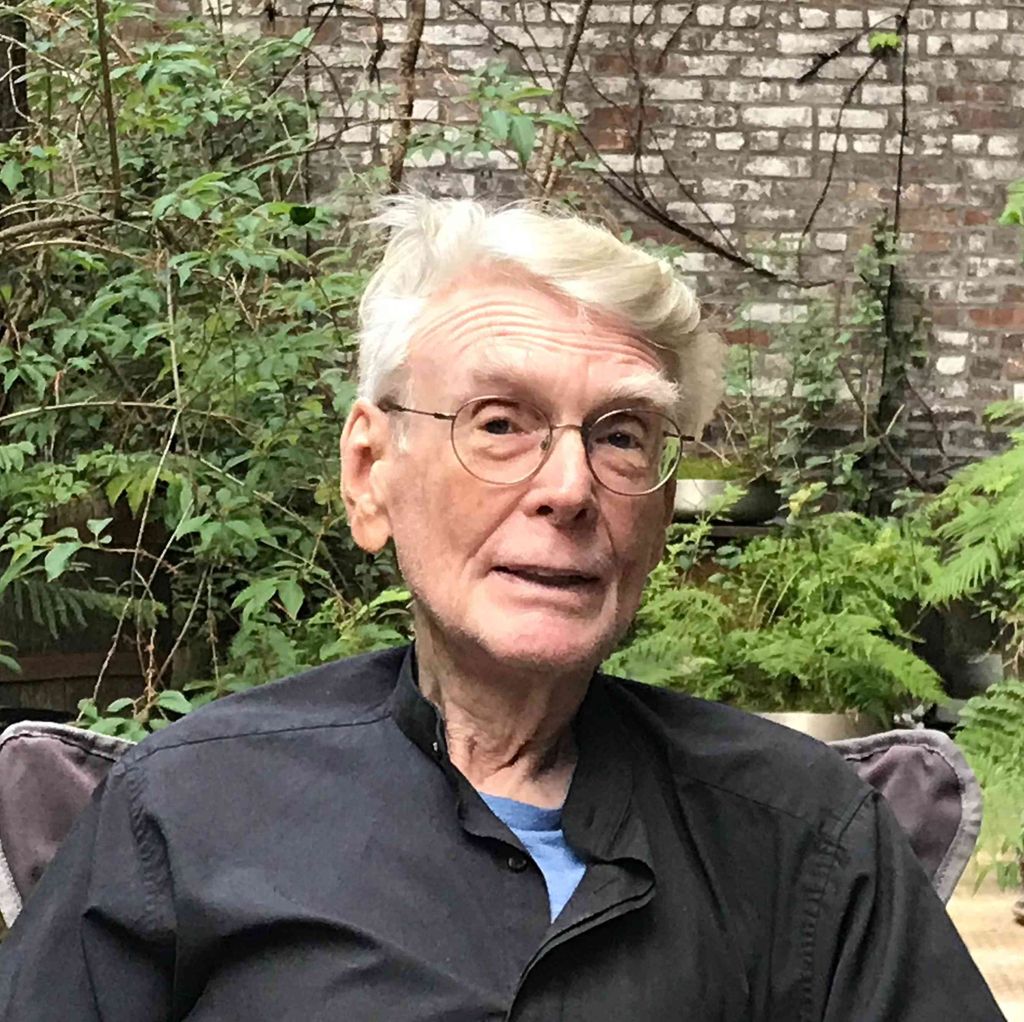
Tom Clancy
1933 - 2025
Share Tom Clancy's obituary with others.
Invite friends and family to read the obituary and add memories.
Stay updated
We'll notify you when service details or new memories are added.
You're now following this obituary
We'll email you when there are updates.
Please select what you would like included for printing:
Sculptor Tom Clancy, 92, passed away early on Tuesday morning September 16, 2025 of natural causes. Artist, father, husband, teacher, raconteur landlord, loft dweller and a life-long New Yorker, Clancy preferred to be thought of as an inventor. He was certainly an inventor of life. Clancy's work as a site-specific sculptor in the 60's, 70's and 80's along with his presence as an educator of some artists now in the vanguard of art, characterized his understated but significant impact. Clancy's work "Memoriam" was installed in the central mall of Pratt Institute, and was featured in Dore Ashton's "American Art since 1945" (1982). He was the recipient of both the National Endowment Grant for Sculpture ('81) and the Guggenheim Fellowship for Sculpture ('74). He was a forerunner of sculptors whose work now appears to New Yorkers routinely in site-specific offerings. Additionally, he was a member of "55 Mercer," an artists' cooperative gallery in Manhattan in the late '60s. The gallery was a hub for experimental artists. His contemporaries and colleagues in the downtown art scene of that day included Ronald Bladen, Melvin Edwards, Eva Hesse, Tom Doyle, Gordon Matta-Clark and Ursula Von Rydingsvard, who was also a student of Clancy's. His body of sculptural work was composed of simple materials, including concrete and steel, which were often used in architectural construction, engineered to subvert the assumed roles of the material. The sculptures were often monumental in appearance, and their large scale created a sense of place, like "Sparrow" his 100' by 4' by 4' slab of concrete, steel and ice in Socrates Sculpture Park in Queens in 1987.He notably participated with "Gold Corner" in the 1969 exhibition, "A Plastic Presence," at the Jewish Museum in New York, featuring works by Eva Hesse, Mon Levinson and Dewain Valentine. The exhibition travelled to Milwaukee Art Center and San Francisco Museum of Modern Art.
Born in 1933 in Brooklyn, NY to Joseph Ignatius Clancy and Sophia Martina "Florence" Clancy (nee' Barden), his mother died of cancer in 1943, as did his sister Rosemary Clancy the following year. Clancy subsequently grew up with his older brother, Joe, just as WWII was coming to an end. In 1963, his brother died in a solo plane crash, a month after his father passed away from heart failure. Losing members of his family early in life influenced the fragility of time in his work, focusing on the impermanence of reality and the velocity of change rather than pain or discomfort.
Although intent on a career in art as a young man, he served four years in the United States Air Force Strategic Air Command and worked as an intelligence officer in South Dakota and later in Massachusetts at Westover Air Force Base during the Korean War. Following a showing of his work in Mexico City in the late 1950's, he met and soon after married Libya Gonzalez, with whom he built his life and family. With Libya for more than 50 years they grew a thriving family and eclectic community of friends from every walk of life.
His pedagogy and teaching were equally influential. As a young artist he was a proud non-graduate of Pratt, Cooper Union, Parsons and The Arts Students League but later, notably served as an instructor in the earliest days of The School of Visual Arts sculpture program, The Rinehart School of Sculpture at Maryland Institute, Columbia University and the Ridgewood School of Art in New Jersey, thereby influencing the development of many artists.
Clancy was also among the early "loft-dwellers": visual artists who found and made homes in the former factory buildings of an area just south of Canal Street in the area now known as Tribeca. Clancy and his wife Libya were lifelong residents of Leonard Street where besides building a home he quietly created a destination for many artistic careers to blossom. Despite a lifetime of large scale projects, he was proudest of the sprawling rooftop garden on top of the Fort Green Brooklyn loft building he restored from scratch. Clancy was a lifetime fan of judo, vanilla ice cream, welcoming friends to the loft, but more, traveling the world on adventures with Libya and their family or just around Manhattan waterways in a zodiac inflatable boat.
In a 2022 retrospective on his life and work, edited by Marina Gluckman and Tiffany Bell, Clancy shared his perspective on art: "Art is a part of everyday life for all of us and the differences among us are largely a matter of modes, materials and methods. The graffiti artist, the opera singer, the street dancer, architect, the ad writer, the preacher, the philosopher, the scientist, the poet and the politician are each participating. I'm not asserting that each is equally important to each of us but rather the energy they feed on is from the same source. The cumulative effect of our universal participation propels and shapes our world."
His wife Libya Gonzalez Clancy predeceased him in 2018. He is survived by his daughter Cathleen Clancy and her husband Brian Kelsall of Washington , D.C. , son Tom Clancy and his wife Jessica Stockton Clancy , also of D.C., grandchildren Colin Clancy Kelsall of Boston,MA, Nora Clancy Kelsall and her husband Rolando Bautista Montesano of New York City, Maya Clancy and Keira Clancy of D.C., nephews Joseph Hamilton Clancy and his wife Karen Kitz-Clancy of New York City, Daniel J. Clancy and his wife Suzanne Clancy of White Salmon,WA, great nephews Joseph Edward Kitz-Clancy of New York City, Dylan Clancy of White Salmon, WA, great-niece Savannah Clancy and her husband Miguel Henderson and great-great-niece Freydis Henderson Clancy, also of White Salmon, WA.
tomclancyartist.net
"Clancy: Creating a Sense of Place A New York Sculptor'sTom Clancy: Creating a Sense of Place A New York Sculptor'sApproach to Site 1960-87" - Marina Gluckman
Tom Clancy's Guestbook
Visits: 77
This site is protected by reCAPTCHA and the
Google Privacy Policy and Terms of Service apply.
Service map data © OpenStreetMap contributors