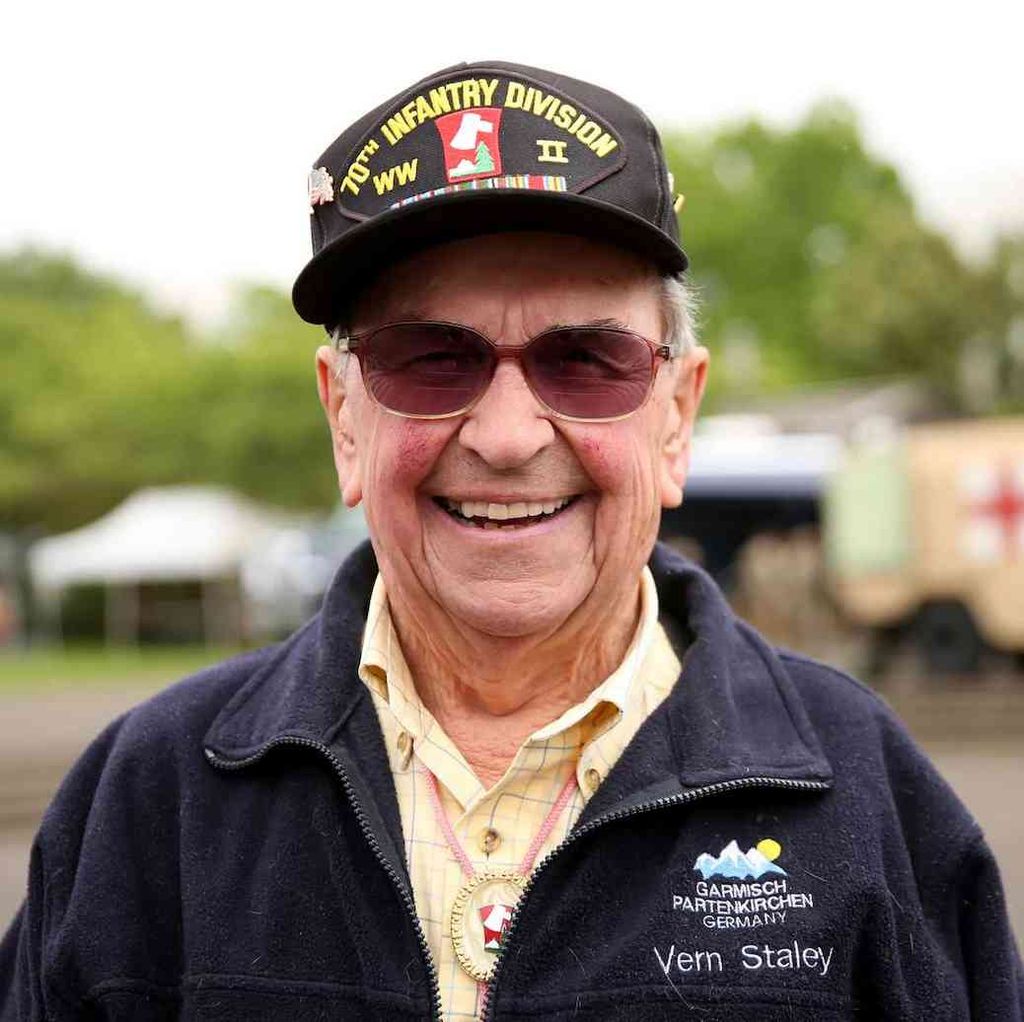
Vernon "Vern" Albert Staley
1924 - 2026
Share Vernon "Vern" Albert Staley's obituary with others.
Invite friends and family to read the obituary and add memories.
Stay updated
We'll notify you when service details or new memories are added.
You're now following this obituary
We'll email you when there are updates.
Please select what you would like included for printing:
March 26, 1924 - February 1, 2026
Vernon Albert Staley, a beloved World War II veteran, devoted family man, skilled machinist, and lifelong volunteer, passed away peacefully on February 1, 2026, at the age of 101.Born March 26, 1924, in the family home in Prineville, Oregon, to Ed and Josephine (Bastonero) Staley, Vern was the eldest of five children: Pearl, Robert, Edward, and Betty. In 1932, the family moved 22 miles east into the Ochoco Mountains along the old Highway 26, where his father operated a cinnabar mine. Young Vern worked alongside him in the mine and attended the one-room Howard School. He and his siblings cherished the freedom and rugged beauty of the outdoors. The family returned to Prineville in 1938.At Crook County High School, Vern excelled in metal and woodworking classes and loved inventing things. In woodworking, he crafted lamps, bookends, a magazine rack, and a small table—items still cherished and used by family members and friends today. During those years, he began working at Prineville Machine, launching a lifelong career as a machinist. Vern graduated in 1943 and was soon drafted into the U.S. Army. He was assigned to the 274th Infantry Regiment, part of the newly formed 70th Infantry Division ("Trailblazers"), activated July 15, 1943, at Camp Adair, Oregon. He completed basic training at Camp Adair, then received advanced medical training at Fitzsimons General Hospital in Denver, Colorado, mastering wound care, basic surgery, and combat medicine. He later trained at Fort Leonard Wood, Missouri, gaining hands-on experience in field medicine, casualty evacuation, and working alongside infantry units in simulated combat. Vern often recalled that medics were initially teased as "pill peddlers" because they carried no weapons. But once the 70th received orders for the European Theater and the realities of combat emerged, his fellow soldiers quickly came to see the medics as true lifesavers. The shift began aboard the troopship crossing the Atlantic, when soldiers approached him quietly: "If I get wounded over there, will you patch me up?" Those earnest questions marked the start of the deep trust he would earn under fire
On December 1, 1944, his unit sailed from Boston to Marseille, France. Just days after arrival, they were rushed north to the front lines in Alsace-Lorraine to help contain German counteroffensives, reaching their positions on Christmas Eve 1944. As a combat medic with the 274th Infantry Regiment, Vern served through three major campaigns:
1. Ardennes-Alsace (December 1944-January 1945): The division held defensive positions along the Rhine in northern Alsace, helping stop Germany's last major Western offensive, Operation Nordwind (launched January 1, 1945). The most notable engagement involving the 274th Infantry Regiment and elite SS forces occurred in early January 1945 around Wingen-sur-Moder, France. This was a brutal fight during the German Operation Nordwind counteroffensive.
- On January 4, 1945, elements of the 2nd Battalion, 274th Infantry (including its medical detachment) moved to Puberg and prepared to attack Wingen-sur-Moder, which had been captured by the 12th SS Mountain Regiment (Gebirgsjager) of the elite 6th SS Mountain Division "Nord."
- These were highly trained mountain troops (often referred to as SS troops in veteran accounts), and the battle involved intense house-to-house and forested combat in freezing winter conditions.
- The 2nd Battalion, 274th Infantry, launched attacks starting January 5-7, 1945, to retake the village. Fighting was ferocious, with heavy casualties on both sides—the Americans faced sniper fire, machine guns, and close-quarters combat against determined SS defenders.
Vern treated wounded soldiers under terrifying fire, pushing past his own early aversion to blood and working closely under the leadership of Captain Frank Ellis, the 274th Regimental Surgeon (known as "Doc Ellis"). One haunting memory stayed with him for life: on the outskirts of Wingen-sur-Moder, his unit was ordered to cross an open field to reach a cemetery where they were to dig in. They came under sniper fire, and Vern ran forward to reach the wounded. One soldier needed urgent evacuation. As Vern and another soldier began to lift the casualty, enemy gunfire erupted again, killing both the wounded man and the other soldier. Every time anyone moved, German fire pinned them down. Vern lay pinned and frozen in the snow all day. When the Germans finally withdrew, he was so numb from the cold that he was unable to walk and had to crawl through the snow to rejoin his unit. He then helped evacuate the remaining wounded. Years later, Vern noted that the severe cold likely kept many from bleeding to death.
- The 2nd Battalion suffered around 130 casualties but succeeded in liberating Wingen by January 7, forcing the SS troops to withdraw. The battalion earned a Presidential Unit Citation for this action.
2. Rhineland (February-March 1945): The 70th attacked south of the Saar River on February 17. The 274th captured high ground overlooking Saarbrucken, took Forbach and Stiring-Wendel, and assaulted fortified Siegfried Line bunkers and pillboxes.
3. Central Europe (March-May 1945): On March 20, the 274th spearheaded the Saar River crossing and helped capture Saarbrucken. The division advanced deep into Germany, taking dozens of towns, overrunning Siegfried Line defenses, capturing 668 prisoners, and pushing toward Mainz, Wiesbaden, and Frankfurt until Germany's surrender on May 8, 1945.
Miraculously, Vern emerged from four months of heavy combat unwounded. Reflecting quietly in later years, he said, "The only thing I've figured out is the Man upstairs had bigger and better things waiting for me, so He kept me around." Vern earned the Combat Medic Badge and a Bronze Star.
Following a year of occupation duty in Germany, Vern returned to the United States in March 1946. He was hospitalized at Madigan General Hospital at Fort Lewis, Washington, for nearly three months, treated for severe jaundice and hernia repair. Wanting to spare his family worry, he wrote that he would be home soon, without mentioning his illness or hospitalization. His father, Ed Stlaey, a World War I veteran, grew impatient when other sons had returned home and Vern had not yet arrived. He and the family traveled to Fort Lewis to find Vern but they were not allowed past the gate. For several days Ed kept talking to the gate guards, insisting they find his son and noting that the Army was just as disorganized as it had been in WWI. Eventually the guards located Vern on the hospital rolls. The family was allowed on post, and they found him in Madigan General Hospital asleep in his hospital bed in a large open ward. He was thin and pale but past the worst. Vern was released in May 1946 and returned to Prineville. He resumed work at Prineville Machine, reconnected with fellow veterans, and gradually readjusted to civilian life. His wartime service as a combat medic, under the guidance of Captain Frank Ellis, had a lasting impact: Ellis recognized Vern's skill and composure under pressure and encouraged him to consider a career in medicine. Though Vern ultimately chose to build his life in machining and family, that encouragement deepened his respect for the healing professions and his commitment to helping others throughout his life. In 1949, he began dating former high-school classmate Shirley Krog. They married on June 11, 1949, beginning a loving partnership of nearly 54 years filled with "a lot of good times." Together they raised three children: Anton (Tony), Victoria (Vicki), and William (Bill).In 1956, the family moved to Stayton, Oregon, where they enjoyed Sunday drives to the Oregon Coast, visits with friends, and frequent family reunions. In 1965, they took a memorable cross-country camping trip, visiting Yellowstone National Park, the Little Bighorn Battlefield in Montana, the Black Hills and Mount Rushmore in South Dakota, Vern's sister Betty and her family in Gering, Nebraska, and Salt Lake City. Vern worked at Willamette Plywood Mill in Aumsville and later at Salem Iron Works, advancing to machinist shop foreman through skill and dedication. He later drew on decades of expertise in a senior sales role with CWS Corp. (later acquired by Sulzer Escher Wyss, Inc.), securing contracts with competitive pricing based on his deep understanding of machining processes, materials, labor, and costs. In his work, Vern was a generous teacher, always ready to share good advice or tricks of the trade. One favorite piece of wisdom: in any organization, figure out who truly holds the power—and realize it's not always the person with the formal title. Vern retired in 1991. In retirement, he and Shirley became cherished camp hosts every August at Memaloose State Park through 2002. After Shirley's passing on May 26, 2003, from complications following heart surgery, Vern continued hosting for a total of 20 years, later at Silver Falls State Park. He loved people and was genuinely interested in their lives. He always called camp hosting "wonderful. "For many years, Vern hosted lively annual July reunions for the extended Staley and Krog families, remembering every story, milestone, and detail about relatives and friends. A lifelong giver, he also organized reunions for the Crook County High School Class of 1943 (later combining them with other 1940s classes). He was deeply involved with the Knights of Columbus, serving as Grand Knight and working countless parish breakfasts and celebrations. True to his motto, he was never one to "just sit around and grow moss. "When most WWII veterans returned home, they focused on family and career, burying the war and seldom speaking of it. By the 1960s, with careers established and children grown, many began reconnecting with old comrades. Veterans' organizations formed, including the 70th Infantry Division Association in 1962. Vern joined enthusiastically and made many close friends. He traveled to Europe multiple times to visit WWII cemeteries and monuments, placing flowers on the graves of dear buddies near Spicheren, France. Given his love for people and gatherings, Vern teamed up with Brian Ellis (son of Doc Ellis) to organize and host Western States Reunions for 70th members—originally for those in the West but soon drawing attendees nationwide. Held every two years (alternating with the full association reunions), these events ran smoothly and were always fun. Vern was also involved in other 70th projects: creating, moving, and refurbishing division monuments; giving countless talks to schoolchildren; and sharing interviews with historians. He served as association president from 2014 to 2016, then became a permanent executive committee member, heading the nominating committee. He received the Outstanding Trailblazer Award in 2006 and, in 2023, was the first (and only) recipient of the new Oak Leaf Award—honoring continued diligent service at least five years after the OTA. It hung proudly on his wall. Vern began throwing annual birthday parties at age 95 and was determined to reach 100. He joyfully celebrated his 100th and 101st birthdays surrounded by family, friends, Trailblazers Association members, and even French WWII reenactors who knew him from his return trips. He was eagerly planning his 102nd at the time of his passing. Vern is survived by his children: Anton (Tony) Staley (Jackie) of Green Bay, WI; Victoria (Vicki) Stewart of Stayton, OR; and daughter-in-law Rochelle Staley of Blaine, MN. He is also survived by grandchildren Megan Tulia Krolnik (Jim) and her children Tahmei, Nolynn, and William of Brooklyn Park, MN; Neal Staley (Amy) and their children Josephine and Margot of Plymouth, MN; his sister Betty McDaniel of Woodland, CA; and many extended family members and dear friends. He was preceded in death by his parents; siblings Pearl, Robert, and Edward; wife Shirley; son William (Bill); and many wartime comrades. Vern's quiet strength, deep faith, selfless service, and boundless love for family and country left an indelible mark on all who knew him. He will be forever remembered for his humility, gentle humor, and unwavering conviction that he was spared for a purpose. A funeral Mass will be celebrated on March 28 at 10:00 a.m. at St. Mary's Catholic Church in Shaw. In lieu of flowers, memorial contributions may be made to the Ellis Family Education Scholarship Fund at https://70th-infantry-division-association.square.site/. This fund, established by the 70th Infantry Division Association, honors the Ellis family—particularly Captain Frank "Doc" Ellis (Vern's regimental surgeon) and his son Brian (Vern's longtime collaborator on reunions and association work)—by providing scholarships to descendants and relatives of 70th Division veterans, supporting education in the spirit of service and legacy that Vern embodied.
Vernon "Vern" Albert Staley's Guestbook
Visits: 225
This site is protected by reCAPTCHA and the
Google Privacy Policy and Terms of Service apply.
Service map data © OpenStreetMap contributors