PHILLIP LEONIAN Obituary
Phillip Marshall Leonian, photographer and chairman of the Phillip and Edith Leonian Foundation, died at his home in Chicago on September 15, 2016. He was 89 years old.
Leonian was an innovative photographer who specialized in advertising and editorial work in New York from the 1950s through the eighties. His clients included IBM, AT&T, Alka Seltzer, General Foods, General Motors, General Electric, Time, Look, and Sports Illustrated (for which he produced eight cover photos, including his iconic portrait of Muhammed Ali bedecked with crown and red velvet robe.)
Capturing the essence of motion particularly fascinated him. Leonian’s photographs of people in motion seem to define time as well as space. He spent his life exploring ways to portray both an object in motion and the very motion itself, and to do it all in a single still photographic image. Following in the pioneering steps of photographers Eadweard Muybridge and Harold Edgerton, Leonian extended photographic possibilities with a science-based approach. His methods of capturing movement ranged from long exposures to moments frozen by repeating stroboscopic flash. He was especially sought out by agencies and art directors when they needed photographs interpreting motion. He photographed the 1968 Olympic Pentathalon for Sports Illustrated, then developed a portfolio that included long distance runner Steve Prefontaine, figure skater Janet Lynn, and basketball player Earl “the pearl” Monroe. His single-negative photo documentation of Cathy Rigby’s balance beam routine was included in the Voyager Golden Record time capsule launched aboard both Voyager spacecraft in 1977. In 1972, the New York Times wrote, “Like (Etienne Jules) Marey, Leonian aims at knowledge. He wants to see and show how people move; and like Marey, he also does something else.”
What he accomplished, as expressed by Tom Vanderschmidt, former Sports Illustrated Picture Editor, was “...(he) brings the excitement of a sport into a still picture. He brings the movement, feeling and noise of it to the magazine page. There have been no pictures of gymnasts equal to what Phil did...His ice-skating pictures are special. For the first time, people could see what was going on. The positions, where the skater’s head and feet were: it was all laid out.”
In Leonian’s own words: “I like giving answers. Making a photograph is like giving an answer. And you get paid for it.”
Leonian also was an expert on intellectual property law. For 20 years he penned a column and was a contributing editor for Camera 35 magazine. He was an inventor and a holder of patents for his lightweight tripods and light stands. And he was a revered teacher and mentor to young photographers.
Phillip Leonian was born on January 13, 1927 in Morgantown, West Virginia, to Leon and Nell (Lanham) Leonian. His involvement in photography was the result of a coin toss. He needed to join an extracurricular club and had narrowed his choices to two: photography and astronomy. The nickel came up heads, and he was a photographer from that moment on. In 1945 Phil was drafted three months before his high school graduation and he joined the paratroopers. Fortunately his unit (187th Glider Infantry) was still in the states in early August when the atomic bombs were dropped, and Japan surrendered. While stationed in Japan during the occupation, Phil worked as a medic. After his discharge he studied chemistry and biology (briefly) at the University of West Virginia, then went to the Brooks Institute of Photography in Santa Barbara (CA). While attempting to make a living on the west coast, a New York photographer breezed into town and took several anticipated jobs away from him. He decided to become a New York photographer. With a bus ticket and a $100 gift from his mother, he moved to the Big Apple.
In 1955 he met Edith Rosenbaum, daughter of Paul and Gabriella (Kramer) Rosenbaum, of Chicago. They married in 1957 and Edith become his representative. Their photography studio was a welcoming place where friends and colleagues from the photo world congregated and talked shop. Sometimes visitors would be roped in to become Leonian’s subjects, as he tested films, cameras, or light meters, exploring new ways to capture motion and all the possibilities of the medium itself.
In the photography world, Leonian was sometimes referred to as a genius. Those who worked with him witnessed an extraordinary intellect coupled with an equally extraordinary confidence in his own abilities and approach. He often related an interchange he had with Muhammed Ali while they were doing “…something about how Ali boxes for Sports Illustrated. I said ‘When we do a thing on boxing like this, we go to the very best there is.’ Ali came out with an obvious answer: ‘You mean you couldn’t have done this before I came along?’ And my answer was, ‘No, we couldn’t have done this before I came along.’ ”
In the 1980s Edith inherited her father’s Chicago-based business. She and Phil began commuting to Chicago and, a few years later, they purchased a second business, Swap-O-Rama Flea Markets. But they always maintained a residence and photo studio in New York City, and spent as much time there as they could.
In 2010, they created the Phillip and Edith Leonian Foundation, which has a mission to raise awareness of and appreciation for photography and photographers. The Foundation specializes in assisting small, non-profit art spaces with strong photography exhibition, publication, and community educational programs.
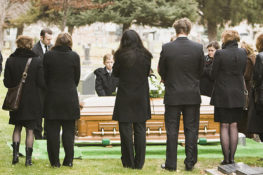
Predeceased by Edith in 2013, Phillip Leonian is survived by his two brothers Armen Leonian and John Leonian, a niece Tania Leonian, and nephews Tarquin Leonian, John Michael Leonian and Joseph Robert Leonian. Phillip and Edith are buried at Woodlawn Cemetery in the Bronx, in the Holly Plot. www.thewoodlawncemetery.org Donations in memory of Phillip Leonian may be made to Bronx Documentary Center, 614 Courtlandt Avenue, Bronx, NY 10451
Published by Chicago Tribune on Nov. 3, 2016.