Randall Edward McNally, MD
Randall Edward McNally, MD
Obituary
Guest Book
Randall McNally, MD Obituary
Cut Man for Chicago Blackhawk Legends - Married 61 years, Father of 10.
Chicago Sun Times obit, July 29, 2022: https://chicago.suntimes.com/obituaries/2022/7/29/23283693/randall-mcnally-plastic-surgeon-napalm-girl-vietnam-kim-phuc-phan-thi-chicago-blackhawks.
Chicago, IL. July 26, 2022: Randall Edward McNally, MD, 92, an irascible, droll and gifted surgeon whose discipline, raw talent, artistry and deadpan Irish humor brought him from a Depression-era childhood in an unheated attic on Chicago's South Side to the University of Notre Dame and on to become a cut doctor for the Chicago Blackhawks and one of the nation's most respected plastic surgeons -- a pioneer who taught four generations of surgeons -- died peacefully with his family beside him in Lake Forest, IL., on July 25 due to complications from old age. He was married for over 60 years, was the father of 10 children, and leaves behind three new generations and scores of descendants.
A one-time Captain in the U.S. Air Force -- during the Vietnam War (and 50 years ago this summer) Dr. McNally was the first U.S. surgeon to treat 9-year-old Kim Phuc, whose photograph - depicting a girl, naked with arms outstretched, clothes burned away, fleeing on a road - won the Pulitzer Prize, and remains one of the most iconic and haunting images in U.S. history. Ms. Phuc grew up to become a physician, and in a network documentary she credited McNally with saving her life.
After defecting to Canada years ago, Dr. Phuc searched for Dr. McNally and was reunited with him in Chicago, first in 1996, and visited him until 2019. On the day before he died, she called him on his deathbed. Dr. Phuc said that she loved him, called him "father," and thanked him for his role in giving her this life.
A military man from a military family, Dr. McNally's grandfather was Pvt. John McNally of NY, a refugee from the Irish Potato Famine, who fought at Gettysburg. And Dr. McNally's father, Sgt. Edward E. McNally, fought in the trenches of France during WWI. The lives of those 3 warriors span nearly two centuries of Irish and U.S. history, from approx. 1846 to 2022. Dr. McNally's namesake and son, Lt. Cmdr. Rand McNally ("Atlas"), was a Marine Corps and Navy carrier pilot and Stanford Law School graduate who gave his life for his country when his A-6 Intruder went down in San Francisco Bay in 1994.
Dr. McNally practiced in Chicago for over 50 years. For much of the 1990s he served as Chairman of the Dept. of Plastic and Reconstructive Surgery at Rush Univ. Med. Center in Chicago, where during 1998 - 2004 he also served as Assoc. Dean of Surgical Services and Sciences at Rush Medical School. He was a founder and later President of the Chicago Society of Plastic Surgeons, and in 2004 what is now the Illinois Plastic Surgery Society named him for its first-ever Lifetime Achievement Award.
A creative surgeon and teacher, he was a leading figure in the development of plastic and reconstructive surgery as a core medical specialty. Said Dr. Craig Bradley of Chicago, "Rush is a teaching hospital, and for over 50 years, during a time of a radical change, Randy McNally taught the teachers."
Bradley says that McNally "was a surgeon's surgeon, a wizard with a scalpel." Bradley says that McNally "helped to invent conceptual plastic surgery, setting aside outdated formulas to instead visualize his artistry and each individual patient in three dimensions. And to invent solutions from the evidence at hand." McNally told his students: "Let the wound speak to you - and listen."
McNally was for 61 years the husband of Margaret Kenny McNally, an energetic redhead and a Gold Star mother who raised 10 children, whose families have resulted in 30 grandkids and 14 great-grands. As one daughter remarked, together their parents "experienced all the trials and triumphs that life on Earth has to offer," and "took it all in stride with an unshakeable faith" in God, love and family.
Dr. McNally was a surgeon of intellect, wit and quiet charisma and leadership who freely dispensed the distilled wisdom of his Irish legacy in lessons and humor in the OR, his family and the larger world. And through the work of his hands and voice and those of others he became connected with some of the great events and personalities of his times. And as a result his words, his humor and his wisdom were often amplified as they made their way into Presidential speeches, Hollywood sound stages, and television broadcasts.
The Girl in the Photograph.
From the Korean War until the 1980s, McNally served in the U.S. Air Force Reserve. As an active duty Captain in the Air Force during 1960-62, McNally served as a burn surgeon in San Antonio, treating the earliest casualties of the Vietnam War. But it was several years later that his own story became intertwined with one of the most singular narratives of the Vietnam era.
It was on June 15, 1972, that his brother-in-law, Thomas Kenny, CEO of the B.C. Ziegler Co., was killed with his wife, 4 children and 76 others when their Cathay Pacific flight from Bangkok to Hong Kong exploded over the central highlands of Vietnam. A Thai airport policeman was charged with putting a bomb on the plane, along with his young daughter and his fiance, who he then heavily insured.
The war was in full throttle, and Dr. McNally flew to Saigon to assist in the recovery, identification, and return of the Kenny family. Sidelined by delays and the war, Dr. McNally undertook volunteer service as a reconstructive surgeon, including for Vietnamese children who'd been injured or disfigured by the war.
One such patient was a 9-year-old girl, Phan Thi Kim Phuc, who days earlier had suffered third degree burns over half of her body, when South Vietnamese forces erred in dropping napalm on her village. According to Kim Phuc and Rush Univ. Medical Ctr., McNally was Kim's primary surgeon for a series of 3 critical operations at the Barsky Burn Center at Cho Ray Hospital in Saigon during June and July, during which he trained her caregivers and grafted skin from her thighs and buttocks to cover life-threatening injuries from the devastating burns.
The photograph that AP's Nick Ut took of Kim in the moments following the bombing won the Pulitzer Prize, and remains one of the most indelible and evocative images of the war. Kim grew up to become a doctor, defected to Canada, and searched for the U.S. doctor who had saved her. She found Dr. McNally in Chicago in 1996, and visited him over the years.
On the day before he died, she called him on his deathbed, and told him that doctors were her heroes. She said that he had not only saved but also inspired her life. That he had helped her to have a dream, and also to keep that dream alive. She said that "God had a plan for me, for that little girl." That Dr. McNally had helped to both "repair her skin, and to heal her heart." And that as a doctor she would continue to "do good things, and help people until her last breath." She wanted to fly to Chicago to see him. But Dr. McNally died, quietly and peacefully with is daughters Sheila and Tara beside him, at 2:15 a.m., about nine hours after their call.
Lessons for Life from Blackhawk Legends.
During the glory years for the Chicago Blackhawks during the 1960s - 80s, Dr. McNally was the on-call cut doctor for the facial lacerations and broken bones of that bloodier hockey era. In a 2010 Chicago Tribune feature, John Kass wrote about the high regard with which McNally was held by Blackhawk legends like Bobby Hull, Keith Magnuson and Stan Mikita.
Dr. McNally told the players that "Men who get facial fractures often deserve facial fractures." Magnuson was a hot-headed NHL enforcer. McNally recalled Magnuson -- on a night when his nose was basically on the wrong side of his face - pleading: "Is it gonna hurt, Doc?" McNally answered: "Keith, I think you shoulda thought about that before you punched the guy."
The Sun Times reported on a brutal, on-ice collision by Pat Stapleton in a 1971 game against the Montreal Canadiens. "Fifty-two stitches on the outside," Stapleton said, "and at least that many on the inside of my mouth." The paper said that Stapleton's skate-slashed face "resembled a road map, created by Dr. Randall McNally (honest)."
The 2010 Tribune column also quotes Mikita's maxim: "No matter how hard you get hit, you get up and take your next shift on the ice." ("Hockey doctors share tales from the ice: No injury too severe to keep player out of the game," Chicago Tribune, June 6, 2010 https://www.chicagotribune.com/sports/blackhawks/ct-xpm-2010-06-06-ct-met-kass-0606-20100606-story.html
The 10 McNally kids were raised on those maxims, as their father taught that in life, as in hockey, sometimes you have to play while hurt. He said: "You put on the pads. You take the hit. You get back on your feet. And you move on."
His own focus, toughness and discipline were such that -- when Randy graduated from 8th grade, at the John W. Cook school in Chicago in 1943, he earned an award for having never missed a single day of school in 9 years. After suffering a severe spiral fracture on his lower leg in the 80s, he was so impatient with the doctors that he sat up on the operating table and finished sewing up his own leg. And his intellect was such that -- when he completed his residency in 1962 and took the national Plastic Surgery Board exams in San Diego -- he earned the highest grade in the nation.
His service included thousands whose lives he saved or changed as a trauma surgeon in ERs throughout the city. And as a reconstructive surgeon, in restoring the faces of children and others devastated by cancer, birth defects or injuries.
Pioneering surgery.
Dr. Val Lambros of Laguna Beach, a former resident of Dr. McNally's, explained that "In the 1980s, traditional methods for skin grafts that dated back to the first world war were still in wide use. But Randy wouldn't accept the status quo. He pushed past boundaries. Did not ask permission. And led the way with new flap tools for facial reconstruction."
He was the "consummate teacher," said another former student, Dr. George Kouris. "He taught his residents to look beyond what they'd been taught in text books. And to think far far outside the box."
Said Dr. Sami Bittar: "He not only taught us how to fly. He taught us how to soar."
McNally recruited his daughter Sheila straight out of nursing school and into the OR as his surgical equal. And created an integrated and consistent surgical team. Bradley says "Sheila wasn't employed or insured by the hospital. But Randy didn't ask anyone's permission to have her in the OR. He just did it." Bradley says: "It wasn't a thing. At a teaching hospital that was already staffed with resident MDs, nurses didn't close wounds, like Sheila did. Or teach the residents how to sew."
Dr. McNally and nurse Sheila performed surgery side-by-side for over 25 years. Dr. Jim Scheutz says they were like "Michael Jordan and Scottie Pippen." Who "raised the game of pretty much every practitioner who heard about their exquisite teamwork and results." The model was widely copied. Says Sheila: "It was a privilege to work alongside a gifted surgeon who could put victims back together in such an amazing way."
Dr. Lambros also remembers McNally as "wonderfully irreverent, a master of deadpan and one-liners." He recalls Randy meeting with legendary ND football coach Ara Parseghian. McNally explained that a key factor in every life-saving surgery was simply this: Stop the bleeding. What's known as "hemostasis." So he asked the Coach: "What's the most important thing about hemostasis?" And the Coach's response has been uttered in thousands of ERs ever since: "You got to WANT it!"
Randy McNally wanted it. He had a hunger and a determination -- and an intensity, focus and drive -- to change the stars of others, and his own. In his childhood attic bedroom he practiced drumming for endless hours, on top of a stack of magazines (because he had no drums). And as a first-year medical student, he practiced stitching on pigskin -- repetitive movements again and again and again -- until he was better and faster than the Residents and surgeons.
His discipline and exactitude were without compromise. During his long, pre-dawn commutes to the hospital, alone in his car, he would visualize each step of that day's surgeries. Said Dr. Lambros: "Just 'good enough' was never good enough. And he had contempt for hurried, average surgical results."
A son, Dr. Thomas A. McNally, a Univ. of Chicago spine surgeon who serves as the Director of Spine Surgery at Weiss Hospital in Chicago, says that his dad emphasized an "always put your patient first" philosophy when teaching medical students, residents, fellows, and all involved with patient care.
Dr. Randall McNally was the first to hold the endowed chair at Rush as the John W. Curtain Professor of Plastic and Reconstructive Surgery, and was a member of the Chicago Medical Society, the Illinois State Medical Society, the AMA, Chicago Society of Plastic Surgery, the American Society of Plastic Surgery, and the Chicago Surgical Society.
Depression Era Kid.
Randall Edward McNally was born in Chicago to Edward Emmett and Mary Ryan McNally on August 18, 1929, the youngest of 3 children. His father Edward owned and operated a business, the McKee Door Co., that installed garage doors throughout Chicago for decades.
Dr. McNally's grandfather, Pvt. John McNally, fled Ireland and the Potato Famine as a small boy, and fought as a drummer boy at Gettysburg during the Civil War. (Company G, 36th Regiment, NY Volunteers, 2nd Brigade, 3rd Div., Sixth Army Corps.)
John moved to Chicago as a mason. Helped build the 1893 Chicago World's Fair. With his wife Mary had 13 children, but only seven survived childhood. The youngest was Dr. McNally's father, Edward Emmett McNally. Orphaned, it's unknown whether he was born in 1894 or 1896. And by the time he was drafted for WWI, his teeth were so rotted that while still a teen, the Army simply pulled them all out and gave him false teeth.
Edward McNally's son, the future Dr. Randy McNally, was born just two months before the 1929 stock market crash. Randy took his first job at age 9, delivering the Saturday Evening Post door to door. Social Security records show that his first tax withholdings began at age 11, working as a soda jerk at K+K Drug Store on S. Ashland St.
His Aunt Anne McNally Wise and Uncle Norman - an itinerant claims adjuster, with no kids of their own - took young Randy on travels across the country in their fancy Packard sedan. On a trip to NY Randy welcomed in 1941 on New Year's Eve, alone at age 11 amidst the mayhem of Times Square.
By WW II Randy was in high school. During summers he worked as a runner for Thompson McKinnon in the trading pits of the Chicago Board of Trade. When Japan surrendered on August 15, 1945, he was high above the ticker tape canyon of LaSalle St., throwing an avalanche of confetti onto joyful celebrations below.
He graduated from Mount Carmel High School in 1947, was President of the Marching Band, earned a BS in Physics from Notre Dame in 1951, cum laude, where he was senior class Treasurer, and in 1955 earned his MD at St. Louis Univ. Med. School, where he was class President.
Shake down the thunder at Notre Dame.
A tough, skinny, bantam rooster of an Irish boxer, he boxed in the Bengal Bouts at ND, and CYO at Navy Pier. Some say that - in a tough Irish 'hood where bullies were common - Randy had no choice but to learn be a boxer, given his other talent: He was also a competitive baton twirler.
Randy earned 1st Place in more than a dozen baton twirling competitions, including three at Chicago Music Festival events widely regarded as an informal national championship. A Chicago Tribune account on July 6, 1941 features a photo of McNally, 11, describing him as "one of the youngest competitors in the contest."
His skill as a drummer - and as a performer who could still twirl batons well into his 90s - brought him a role as a Drum Major for the Notre Dame Fighting Irish Marching Band. Performing alongside the undefeated teams of Frank Leahy, he saw two national championships, one of which he's credited with helping to win, during halftime, from the drum major's perch at center field.
On Nov. 12, 1949 McNally and the ND Band rode a train to NY for a match-up against UNC in Yankee Stadium. Carolina scored first and held a sluggish and downcast ND to a 6-6 tie at halftime. Things weren't looking good for the Irish.
But all that changed when the halftime show reached its finale - and Randy hurled his spinning baton 50 feet into the air. Witnesses say that the crowd gasped. Held its breath as the baton slowly spun. High above midfield. Glinting in the autumn sun. McNally crouched far below. Face expressionless. Time almost stood still.
Then McNally rocked the stadium with an epic, behind-the-back, no-look catch that left the crowd first stunned -- and then erupting into a wave of cheers -- just as ND ran out of the tunnel for the 2nd half. According to family lore, the cheers electrified the team. Ignited the Irish. Turned the game around. And sparking six unanswered touchdowns. ND went on to win what is perhaps college football's only National Championship that's been widely credited to a baton twirler.
A few months later, at age 20, Randy spent the summer of 1950 traveling across Europe with a group of ND students. At the end he peeled off and made his way to Ireland, solo, bought a used bike and traveled across the country.
Margaret Kenny - a Gold Star mother of 10.
As a 1st year med student in St. Louis, he met his future wife, Margaret Anne Kenny. A daughter of D.J. Kenny and Olive Kauffung of West Bend, Wisc. D.J. was an officer in WWI, the CEO of B.C. Ziegler, and a two-time GOP nominee for Governor of Wisconsin.
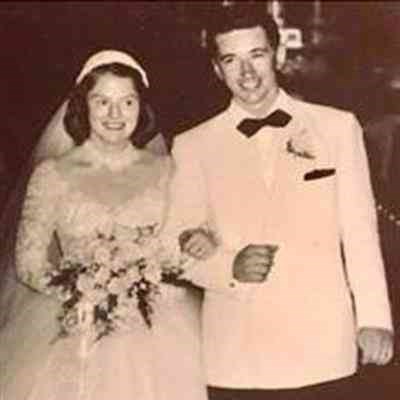
Randy & Margaret McNally were married at Holy Angels Church in West Bend on June 20, 1953, a day so hot that bridesmaids fainted and it broke county records. Their daughter Anne was born on April 10, 1954, the first of what some call "Irish triplets" -- 3 babies born, each less than a year apart. During the next 14 years, Margaret gave birth to 10 children, 5 girls and 5 boys.
The two raised the 10 children in a series of rambling houses in Northbrook. They spent summers in Wisconsin amongst 36 cousins in the family place where Margaret had grown up on Big Cedar Lake, and later at an art deco home on Lake Geneva, not far from where Randy had worked on farms as a young boy. Today 4 of Dr. McNally's children make their homes at Lake Geneva, including Maureen, Tara, Patrick and his nurse Sheila, who saved his life during a downturn two years ago, and who cared for him in her home until the time of his death.
In what was reported as a school record, all 10 kids graduated from Glenbrook North HS (Northbrook Star, June 26, 1986), the backdrop for the coming of age films of director John Hughes. According to a profile in North Shore magazine, the children say that their success was the result of "the high standards set and lived by both their parents."
Margaret was a force of nature. Who with her husband was a welcoming presence who hosted events with grace and flair, including weddings, Christmas gatherings, and other imaginative celebrations. Their mother's advice, says Maureen, was: "Dance, have fun, laugh. When you're invited to a party, go. Buy that car, go on that vacation, use the good china." Maureen says that Margaret "taught us how to multi-task, and inspired us with her love for cooking, summer lakes, tennis, cycling and skiing." And describes Margaret as a fashion trend-setter: "I'm pretty sure that she was the first mom on the block to wear hip hugger jeans and clogs."
Among Dr. McNally's greatest gifts was the strength of his marriage. Tara quotes her dad: "The best thing a father can do for his kids is to show them that he loves their mother." He was true to that. In a letter 4 years before his plane crash and death, Navy pilot Rand wrote about his dad and the "wonderful and admirable relationship" he shared with his wife. The pilot called it "the foundation that has sustained all of us," that was "far and away the best love affair I know."
Dr. McNally also saved his wife from a close brush with death. In 1974 she was diagnosed with a deadly melanoma that threatened her eyesight and her life. Although it's rare for a husband to operate on his wife, Dr. McNally performed the exacting eye surgery that resulted in a cancer-free diagnosis and 40 years of additional sight and life.
His daughter Tara, a wife, mother of 5 and TV producer at OWN, says that her mom never took half-measures, that she was full throttle all the way, succeeding with precision, discipline and flair. With Margaret's gifts, work ethic and spark, Tara said, "I often think that if she was born in a different time, she would have been at the top of whatever field she chose. She would have run a company, been in show business, or followed her father into politics."
Tara says that what she appreciates most are the legacies of her parents' deep compassion for others as well as the joy in family bonds. And says that she is most proud of the thousands of broadcasts with everyday people "who shared their stories and empowered Oprah's viewers to live better, healthier, and more connected lives."
His daughter Maureen, a mother of 8, was one of Dr. McNally's closest companions after her mother died in March 2015. Of her dad, Maureen says: "He gave me life. And he gave me a wonderful life."
As a father, grandfather, and person, Randy McNally was supportive. Candid. Patient. Funny. A role model. A warm, wise and regular guy who treated people with decency and respect, who knew the names of the children of the workers in the parking garages, gas stations, and blue-collar bars where he hung out with his wife, children and friends. He had a meaningful, deep and one-on-one relationship with each of his 30 grandkids. His daughter Tara says that dozens of his grandkids and former students explain that his sayings have been playing in their heads "on auto repeat" for many years.
Dr. McNally cared for Margaret and their homes during her final years of illness and of life. He says simply: "There is nothing I could ever do for Margaret, that would ever amount to one one-hundredth of what she did for, and gave to, me and our children."
According to the Chicago Sun Times (link up above), "Dr. McNally is survived by his daughters Tara Montgomery, an executive producer for the Oprah Winfrey Network, Sheila McNally, who worked at her father's side as a surgical nurse, Maureen Morrissey, a physical therapist and clerk for the village of Northbrook, and McNally Sagal, an actor who has appeared on TV shows including "Sons of Anarchy," sons Patrick, an Underwriters Laboratories executive, Ryan, a futures trading executive, Dr. Thomas A. McNally, a spinal surgeon, and Edward McNally, a former U.S. attorney for Southern Illinois who also was a speechwriter for President George H.W. Bush and the White House's first general counsel for homeland security." The Sun Times adds that "Another son, Lt. Cmdr. Randall E. McNally II, a Navy reserve pilot, died when his jet crashed in San Francisco Bay in 1994." And that the McNallys' eldest daughter Anne took her life in 1976 "after studying occupational therapy at Northwestern University."
Epilogue.
Dr. Randall McNally lived a quiet but influential life touched by extraordinary moments. In recent years he regularly expressed profound gratitude for his life, for his Catholic faith, his parents, his education, his wife and children and grandchildren, and the opportunities that he had to serve others through surgery. He often marveled at his journey from that unheated attic bedroom under the rafters at 84th and Wood. And yet, in keeping with a life of both triumph and tragedy, lived with a steady and unflappable humility, when asked about how he should be remembered after he was gone, Dr. McNally said simply that he was "Just one more artisan who lived in Chicago."
The grandson of a drummer boy at Gettysburg, Randall McNally lived until well into the 21st century, wielded his own drumsticks to help "shake down the thunder" at Notre Dame, and wielded his scalpel, his example, his humor, his family and his words to impact hundreds of professionals still practicing today, and through them to heal, improve and often transform the lives of countless thousands of surgical patients and their families.
On his deathbed last weekend, during a moment of discomfort, his daughter Maureen offered water and a blanket, and asked: "What can I do for you, Dad?"
He answered: "Lead a good life."
# # #
Dr. McNally is survived by eight children, 28 grandchildren, and 14 grand-grandchildren: ANNE - died 5/30/76; MAUREEN (formerly Matt) Morrissey, Sean - died 8/6/1985, Margaret (David) Yeager, Scarlett, Tripp, Jack and Ronan Yeager; Kerry (Luke) Nasserbakht, Pearl and Niamh Nasserbakht; DJ, Emmett - died 5/26/1994, the triplets Grace, Shannon and Patrick; EDWARD (Monique Martin), Marguerite Epstein-Martin and Quinn; SHEILA McNally, RN (Bill Ernstrom), Colleen (Mike) Ambrosino, Michael, Catherine and Grace Ambrosino; Bridget (Tony) Pace, Luca Pace; Peter (Stephanie Leal) Hoy, Patrick Merrill, Coraluna and Fianna Leal-Hoy; and Kara (Ryan Timmons) Hoy, Ozzie Hoy; JEAN McNally (David) Sagal, Boris (Sarah), Nora and Finn; Lt. Cmdr. RAND - died 4/5/94; PAT (Sarah), Clark (Taylor), Paddy and John; RYAN, Annabelle (Eric) Donnermeyer and Audrey; Dr. THOMAS A. McNally (Hillary), Randy, Elizabeth, and McKenzie; TARA (Chuck) Montgomery, Sean, Charlie, Flynn, Maeve and Ryan.
# # #
Visitation: Aug. 4, 2022, 4 to 8 pm at St. Norbert Church, 1809 Walters Ave., Northbrook. Funeral Mass Aug. 5 at 10 am at St. Norbert's, Military Honors to follow.
In lieu of flowers: https://rushgiving.com/McNallyTribute; or: http://www.kimfoundation.com/
View All Photos
Add Photos to Memorial
To plant trees in memory, please visit the Sympathy Store.
Joan Schuessler
July 27, 2023
My deepest condolences to the entire McNally family. My memories go back to when we lived together at Kidston House during my husband and Randy´s resident days at Presbyterian Hospital (now Rush Medical Center). He also did the surgery to remove a scar on our daughter´s forehead. Wonderful doctor and person.
Norene Shader
October 15, 2022
My Deepest condolences to the entire McNally family. He was an amazing man, and he raised an amazing family! I worked with Dr. McNally and his daughter Sheila McNally RN, on many occasions as a Nurse Anesthetist at Rush. He had such a witty, dry sense of humor. One day he asked me a question, which I answered, and about 5 minutes later he responded to my answer, which caused me to laugh out loud! That happened many years ago, but it was one of my fondest memories of the OR. He certainly was a man who lived his life well. May God Bless him with peace and eternal life.
Mary Grace (Fitzgerald) Sillies
August 11, 2022
What an incredible tribute to his legacy. May all those around him be lifted up in their grief.
laura ledford (Dr. John Long´s stepdaughter)
August 8, 2022
What a life! what a doctor, what a great guy!
How you can show support
Follow
Get email updates whenever changes are made.
Send flowers
Consider sending flowers.
Add photos
Share their life with photo memories.
Plant trees
Honor them by planting trees in their memory.
Donate in Memory
Make a donation in memory of your loved one.
Share this page
Invite other friends and family to visit the page.
Diane DiBartolomeo
August 7, 2022
I am a former patient of Dr McNally. In 1986, reconstructive surgery was successfully and compassionately performed at Rush with Dr McNally and Sheila. I chose the team because of their professionalism and down-to -earth approach. Outstanding bedside manner. Life changing.
Jay D Ellenby MD
August 3, 2022
I was Randy's resident for 2 years at Rush Medical , and remember him well as a teacher and good friend . I was honored when he asked me to run his office and see his patients in July and August , 1967 , allowing Margaret and him a 6 week vacation .He is well remembered and treasured as a wonderful surgeon , excellent mentor , and friend . Jay Ellenby MD
anonymous
August 1, 2022
The Good Doc did some work on my face at the VA years ago. Asked me if I wanted a PaulNewman or Rock Hudson. I told him Gabby Hayes would do. A real pro and gentleman. I always remembered him. God Bless.
John T. Barron, MD, PhD
July 31, 2022
I was a medical student at Rush Medical College. I did an elective rotation on the plastic surgery service and Dr. McNally was one of the attending surgeons. Dr. McNally was an outstanding, and particularly skilled surgeon. As a plastic surgeon, he would refer to himself as a "psychiatrist with a knife". What he taught me about the approach to a patient and the approach to a case was invaluable to me as a physician, even as a cardiologist, throughout my career. I still remember the clinical pearls he taught me. He was one of the finest doctors and human beings that I have had the privilege to have encountered.
Anun Seetapun M.D
July 31, 2022
My great teacher and forever the legendary plastic surgeon. RIP from ChiangMai , Thailand
Mary Cromer Kelly
July 31, 2022
Sending deepest sympathy to all my dear cousins and your families, and regret that we can´t be with you to celebrate the amazing life of your wonderful father. He was indeed a blessing to so many people, and I´m deeply grateful to have known him.
With much love to all.
Cousin Mark Cromer
July 31, 2022
Uncle Randy was and is one of the finest people I have ever known. We joked a lot. But, it was out of love. I will miss him and always fondly remember our get togethers. My prayers and love are with my Cousins and their families.
Showing 1 - 11 of 11 results
1240 Waukegan Road, Glenview, IL 60025
Make a Donation
in Randall McNally, MD's name
How to support Randall's loved ones

Should I Send Sympathy Flowers?
What kind of arrangement is appropriate, where should you send it, and when should you send an alternative?
Read more
What Should I Write in a Sympathy Card?
We'll help you find the right words to comfort your family member or loved one during this difficult time.
Read more
Resources to help you cope with loss

How to Cope With Grief
Information and advice to help you cope with the death of someone important to you.
Read more
Estate Settlement Guide
If you’re in charge of handling the affairs for a recently deceased loved one, this guide offers a helpful checklist.
Read more

Obituaries, grief & privacy: Legacy’s news editor on NPR podcast
Legacy's Linnea Crowther discusses how families talk about causes of death in the obituaries they write.
Read moreWays to honor Randall McNally, MD's life and legacy
Obituary Examples
You may find these well-written obituary examples helpful as you write about your own family.
Read more

Obituary Templates – Customizable Examples and Samples
These free blank templates make writing an obituary faster and easier.
Read more
How Do I Write a Eulogy?
Some basic help and starters when you have to write a tribute to someone you love.
Read more


