Sarah Cassidy Obituary
Published by Legacy Remembers on Jun. 10, 2012.
All her life Sally Cassidy was a perfect bi-lingual, always available to interpret at
international meetings. Her grandmother on her mother's side was a Du Plessis
from Quebec who insisted that this grandchild be raised by a French governess.
So Sally had none of the collective training in basics which children submit to in
elementary school. Instead, her grandfather welcomed her early to his library
and later ensured that she receive a handsome allowance to buy books of her
own. That grand-father was Charles Augustus Whelan (of the Whelan
drugstores) whose creative mind enabled him to make millions twice: before the
Great Depression, and after he lost that fortune rescuing a brother from
bankruptcy. He was a model for her. They were proud of each other.
For secondary school she went to Noroton where the nuns were bilingual too,
and highly educated. She majored in Philosophy and English at their Manhattanville College, and then went to Fordham University where she got an MA in Political
Science in 1946. That Summer the president of her college saw to it that she join
a group from Notre Dame on a journey to international student meetings in
order to gather information on the needs of European students who had
suffered and were still suffering from the war. She also started sending a
monthly article to the Catholic World about her discovery of 'Specialized
Catholic Action', a set of youth movements whose program was "See, Judge,
Act," each in its own 'milieu', whether school, work, or farm. In order to extend
her stay in France and learn more about the life style and spirituality of these
active laymen she got a lecturer job at an elite women's school in Paris and
returned home early in 1948 to organize an international meeting of Young
Christian Students (YCS) in Chicago for that Summer. She ended up staying
there to complete her graduate studies at the University of Chicago.
Her grandfather had died in 1941, so she had to borrow from one of the YCS
leaders from Kansas City to enter the doctoral program in Sociology in 1949,
after spending a year teaching economics and International Relations at a local college. The Sociology Department at the U of C had a great tradition of
fieldwork in the city which was attracting an adult population of veterans. Sally
enjoyed the learning which went on among fellow students but she also took
courses in other Departments (Psychology, Human Development, History,
Economic Development, etc). She spent part of 1952 in France, collecting data on
its Catholic layman movements; in her dissertation she compared French and
American leaders. During her four years on campus she became known as a brilliant student. She received a fellowship from the Social Science Research
Council to spend 1953-54 in Berkley, working on ways of using the Thematic
Apperception test in sociological research. The breadth of her interests was
unique. It was going to serve her exceptionally well when time came to find a
job.
Actually she did not have to find a job: three jobs in a row came to her starting
in 1954 when she was highly recommended to the Universite de Montreal for
helping launch a Department de Sociology. She spent only a year there, participating in research projects which taught her a lot about the city and Canada.
In 1955 it was the College at the University of Chicago that wanted her back in
one of its interdisciplinary courses (Anthropology, Sociology, and Psychology).
Teaching it consisted essentially in participating in and guiding lively
discussions among mostly bright students. She did it so well that it was one of
her students who recommended her for her next job, a job which was
unbelievably challenging but for which she was actually ready. It happened in the Spring of 1959. She had just officially been granted her PhD.
A committee of scholars at Wayne State University in Detroit had been concerned with the trend that was reducing General Education to consist merely in requiring students to take several introductory courses in different disciplines. The committee had prepared a plan which was promised a large grant by the Ford Foundation for getting the experiment launched. Monteith College would be made up of three divisions, each of which would offer interdisciplinary programs: Natural Sciences, Humanities, and Science of Society. Two of these would be headed by members of the committee but they needed to find a suitable head for Science of Society. It was to bring together disciplines which had a tendency to either ignore or compete with each other. The father of Sally's student was a mathematician, head of the Science Division. He attended one of her discussion sections; he liked what she had to say about General Education. He invited her to Detroit where she was interviewed and the job was offered to her. It was not hard for her to find several members of her team on the Chicago
campus, all of them dedicated to General Education.
The team spent the summer looking for ways in which a coherent program
could allow each discipline to show how it could complement the approach to
the study of society taken by the others. With the help of a philosopher and an
economist, Sally chose the concept of Relation as the one capable of getting the
disciplines to pay attention to each other. But she also had to get all to agree to adopt the method she had used during her years in the College: teaching would
have to be done through raising questions, new questions, more questions, so
that students would learn to think. Section meetings were not to be used by
professors to lecture and give students answers, but to help them rephrase their
questions. It would not be easy but it could be exhilarating. Students would be
frustrated at first but sooner or later they would catch on. For twelve years Sally
made it work. Students got involved in adding new offerings to the plan's
program. These typically included students cooperating with and learning from
each other. When they graduated they were readily admitted to the best
universities' graduate programs
In 1971 Sally Cassidy was offered a job at Boston University. She did not like to
leave Detroit where she had become engaged in other novelties, like helping find new houses for the victims of the riots of 1967, and contributing to the Catholic renewal brought about by Vatican II. Her days of interdisciplinary teaching would be over. But she was given the task of initiating to sociological observation and thinking juniors and seniors who had never taken a Sociology course. She did that in her office, taking into account each student's own interests, talents, and needs (as she had hoped to be taught at Oxford, had WWII not intervened). This was for Sally a new and positive
experiment in General Education.
Boston offered her two other unexpected gifts. First, at the Museum of Art she
discovered a great watercolor teacher, Miss Gretchen Cook. For years she never
missed a weekly lesson. Then, in the mid seventies, refugees from the Vietnam
War started arriving. Sally encouraged her friend Paule Verdet to sponsor a good
many families, first Vietnamese then Hmong. Both women became "mothers" for
them and their children. And suddenly the trust created for Sally by her
grandfather some forty years earlier brought them the money they needed to
care for the successive arrivals of refugees.
In 1992, however, she was made to retire. Her loss of teaching hit her body
grievously, with illnesses from which she never completely recovered. But she
kept painting for another ten years thanks to a new treatment developed at the
Mass Eye and Ear Infirmary against macular degeneration. She also managed to
lose a lot of weight, much to the satisfaction of her wonderful doctors.
Unfortunately her sight worsened, but she could still teach the art of watercolor
to a few adult friends. She became an expert watcher of soccer games; and Paule
and she played a daily game of scrabble in Latin. But in 2010 her sight worsened further and she had to switch to watching football and to being read New York
Times articles on the economic and political crisis.
Then, in the middle of the night toward the end of September 2010, she fell
while looking for an additional blanket; she broke her femur, had successful hip
surgery, and spent six weeks in rehabilitation before returning home in mid-
November. She had not been truly "rehabilitated." She felt "diminished", but she
never complained. She actively cooperated in her care, nourished her spiritual
life with daily reception of the Eucharist and TV Mass, and enjoyed her friendship
with her 15 years old very sick Labrador whom she lost in March of this year.
But she had made friends since January with a young nurse who spent four
hours three days a week caring for all her needs. And it was one of her Hmong
daughters who came late in the evening of June 9 to help Paule make Sally
comfortable in her hospital bed. She went to sleep, and Paule kept watch by her
side, holding her hand. The motions of her neck showed that she was working at
breathing, but did not suggest that she was in pain. She peacefully stopped
breathing at 1:40 AM on June 10.
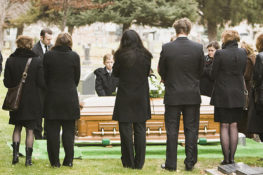
A Mass was celebrated for her funerals on Friday June 15 at her parish church,
Sacred Heart of Newton Centre. There was a good sample of people who had
known and loved her at different stages of her life: from New York state a
nephew and his spouse with two of their sons and their spouses, a niece from
California, old Chicago friends, Monteith students from Detroit and others from
Massachusetts, Hmong refugees living close by as well as a couple from Florida,
BU students, the son of her lone refugee from Vietnam who just moved from
Texas with his wife, a BU colleague and ex-watercolor apprentice, fellow
parishioners, and close neighbors. On Saturday her body was entombed in the Whelan mausoleum at the Holy Sepulcher cemetery in East Orange, NJ next to her grandparents Whelan and her mother. The prayers of the Church were read by a local priest who also sang the great Irish blessing of Saint Patrick. She left us the mission to distribute her best watercolors to everyone who would enjoy them.