
Mieko Nishi Obituary
Mieko Iguchi was born on October 1, 1935, in Chula Vista, California - the daughter of a farmer and businessman Mike Kumataro Iguchi and former schoolteacher Mitsuko Nakai Iguchi. Mieko and her six siblings were raised on the family farms in the Tijuana Valley and Palm City at the southern end of San Diego County. Though her parents were of modest means, they worked hard and provided well for their children. Her father raised celery, tomatoes, cucumbers, and beans, and many other vegetables. In addition, he owned a large packing shed where produce was washed and prepared for shipping. A freight train would stop at the platform and produce would be loaded up, which would then be delivered to major eastern cities. In addition to farming, Mieko's father started a business called The San Diego Vegetable Exchange. It was located in downtown San Diego where local grocers would come to buy produce to sell at their markets.
Mieko went to Emory School in Nestor, California where she attended kindergarten and first grade. She always said that she loved school. But in her first-grade year, in April of 1942 after the bombing of Pearl Harbor, she and her family were directed to board a train, not knowing where they were being taken. They arrived at the Santa Anita Racetrack in Arcadia, California. Here, they were kept for many months living in horse stalls. While thousands of Japanese-American families from the west coast were kept in detention centers like this, internment camps were being readied for them in remote locations throughout the west.
Mitsuko knew that the family would eventually be moved elsewhere, but no one knew where. Mieko's mother ordered snow boots and heavy coats for each of the children from a catalog, and just their luck – their assigned camp was Poston, Arizona where temperatures ranged from 115 degrees to below freezing; and sandstorms, a constant threat, brought sand through the shrunken redwood slats into their makeshift home.
The Iguchi family was assigned to barrack 12, units C and D on Block 329. Life here was extremely difficult. The barracks had no running water, meals were taken in huge mess halls, restrooms and showers were a long walk away in shared buildings, and the hundreds of barracks were surrounded by watchtowers with armed guards and barbed wire. Mieko's father Mike Kumataro had been taken from their San Diego home and separated from the family by government officials months before, but was finally reunited with his wife and children in Poston. He had been kept with other high profile Japanese American men in New Mexico. Mieko's family was confined in this Arizona Internment Camp with 17,000 other Japanese American men, women, and children for three years. Mieko's family were nine of the 120,000 west coast Japanese detained in these camps during the war.
Once they were allowed to return to San Diego, the Iguchis found they were more fortunate than many other Japanese-American families. Their Tijuana Valley and Palm City farms had been maintained in their absence by loyal neighbors. Mieko recalled that six or seven Japanese families who had returned to San Diego without a penny to their name, lived in the family's many outbuildings scattered among their three farms. Some stayed for years until they could get back on their feet. Once the Iguchis reclaimed ownership of their farms, they worked hard to rebuild them into a profitable business again.
Mieko was still a school-aged child after the World War II. She returned to Emory School where she attended fifth grade then moved on to Southwest Junior. Often after their school day, Mieko and her siblings would help on the farm. It seemed there was always work to be done. But there was time for fun, too. Mieko talked about May Pole dances and new dresses, community picnics, movies, and fountain sodas at the drug store. As a high schooler, Mieko and her sisters got jobs at a small market run by her older brother Charlie. It was called Pic-a-Chic. The market sold produce, basic groceries, and meats. One of her jobs was to sort the eggs by candling them. She enjoyed the perks she got from her brother in exchange for working at his store.
Mieko attended Chula Vista High where her favorite subject was English. She insisted that she was shy and never ditched class to go to the beach like "all the other kids." During her senior year, she transferred to the new Mar Vista High School as a member of its very first graduating class. She claimed she never missed a day of high school – and alleged that when she was younger, she even went to school with red marks from chicken pox all over her face.
After Mieko graduated from Mar Vista, she went to beauty school. She lived with her family and took the Greyhound bus to classes at the Broadway Beauty School in downtown San Diego. it was a 9-month course followed by certification board exams.
Soon after, she moved to Los Angeles where she lived with her friend Jean in a place that housed business college students. She worked as a babysitter in Beverly Hills and attended Los Angeles City College where she studied business and secretarial. While at LACC, she had a job at a hardware store called Akron doing secretarial work.
Later, Mieko and her sister Lily became roommates. They lived in an apartment on Orchard Street near the University of Southern California. Her first job as a beautician was at Teri's Beauty Shop in Los Angeles. It was close to the Ambassador Hotel near Wilshire. She did shampoos, cuts, setting, styling, dying, and manicures. The owner was kind. Mieko remembers her boss bringing in Van de kamp's bran muffins to share. Teri's was a small beauty shop. It was just Teri and Mieko and a receptionist. The three became good friends.
At about this same time, Mits Onizuka and Azuma Nishi were pals in Los Angeles. It's not clear who dated or was introduced to the other first, but Mieko and Ozzie got together as did Lily and Mits. Mieko was married to Ozzie in May of 1959. Lily was married to Mits just a year later.
Ozzie and Mieko settled into their first home in Pasadena on Millard Street. Mieko did hair at The House of Luet on Lake Street and Ozzie was a postal clerk. Ozzie's mother, Grandma Nishi, lived in the adjoining home. It was like an old-fashioned bungalow-duplex. While living at the Millard Street house, Shannon, Miles, and Erin were born. During these years, the family attended services at the Japanese Presbyterian Church on Mary Street. Mieko drove Shannon to Pasadena Christian School and took Miles to Head Start then later to Lincoln Elementary. Those were the early days of summers at Grandma Iguchi's house, fun outings at the beach, and dusty truck rides to the ranch with Uncle Kenbo and cousins. Some time later, a new Pasadena Freeway was proposed, and eminent domain was declared on the Millard neighborhood. This meant it was time for a move.
Ozzie and Mieko found and purchased a home in the CalTech neighborhood of Pasadena. They relocated to this home in 1968. Mieko loved volunteering in her kids' classrooms. She was often the children's room mother, bringing treats for parties and helping teachers. Mieko went to parent conferences and PTA meetings, she helped with paper drives and fundraisers. By this time, Parker and Darby were born and the Nishis became a family of seven.
Mieko enjoyed being Mom to her five children – helping with schoolwork and projects, cooking delicious meals, throwing birthday parties, and overseeing piano, violin, and even accordion practice. She was very involved and devoted to her kids, logging hundreds and hundreds of hours in ice skating rinks, gyms, and ball fields across the valley, on tennis courts, in stadiums, and at performance venues. She supported her children in activities from Saturday Japanese school to Suzuki violin recitals and everything in between. So many miles were put onto that pistachio green Grand Torino station wagon – thousands and thousands of them! Even now, her children find it difficult to recall a time when she missed a competition, game, concert, recital, or school program. Later in life she gave this advice, "Be involved with your kids. I think letting each of you kids try lots of different things was important. Each of you were so different in your interests."
Once Darby started kindergarten, Mieko took a job offered to her by Hamilton Elementary, the school across the street. She worked as a teacher's aide for many years – grading papers and creating teaching materials. Years later, she transferred to Cleveland Elementary where she ran an IBM Writing to Read program and worked with reluctant learners. She enjoyed working in schools and the people she worked with.
After Miles and Ozzie passed away in 2000, Mieko retired from the Pasadena Unified School District and relocated to Utah where she was eventually to became Grandma to young Aubrey, Roscoe, Tomio, and Yukio. During this period, she volunteered at Aubrey and Roscoe's elementary school and ran the infamous "Grandma School" for her Utah grands every summer. She loved hosting family dinners and working in her large yard, planting and tending to her vegetables and flowers. Neighbors would see her for hours and hours in the barely-light morning as she would weed and water. Mieko enjoyed road trips to Las Vegas and California to visit family – especially her three California grandkids Cole, Tristan, and Noah. These visits made her very happy.
Mieko's life was a life well lived. She was an extraordinarily strong and determined woman. She enjoyed doing creative projects and didn't mind hard work one bit. She had a soft spot for people experiencing hardship and really enjoyed having family around her. She is survived by her children Shannon (Bill) Moedl, Erin (Stephan) Sugiyama, Parker (Cindy) Nishi, and Darby (Jeff) Lipp, and her seven much-loved grandchildren Aubrey, Roscoe, Tomio, Tristan, Cole, Yukio, and Noah. Preceding her in death are her parents Mike Kumataro and Mitsuko (AKA Mitsuno), brothers Charles Toru and Kenji Henry, husband Azuma, and son Miles. Mieko has been laid to rest at Live Oak Memorial Park in Monrovia, California.
260 East South Temple, Salt Lake City, UT 84111
People and places connected with Mieko
Recent Obituaries
Recent Obituaries
Recent Obituaries
Memories and Condolences
for Mieko Nishi

Make a Donation
in Mieko Nishi's name
How to support Mieko's loved ones

Should I Send Sympathy Flowers?
What kind of arrangement is appropriate, where should you send it, and when should you send an alternative?
Read more
What Should I Write in a Sympathy Card?
We'll help you find the right words to comfort your family member or loved one during this difficult time.
Read more
Resources to help you cope with loss

How to Cope With Grief
Information and advice to help you cope with the death of someone important to you.
Read more
Estate Settlement Guide
If you’re in charge of handling the affairs for a recently deceased loved one, this guide offers a helpful checklist.
Read more

Obituaries, grief & privacy: Legacy’s news editor on NPR podcast
Legacy's Linnea Crowther discusses how families talk about causes of death in the obituaries they write.
Read moreWays to honor Mieko Nishi's life and legacy
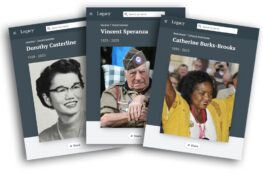
Obituary Examples
You may find these well-written obituary examples helpful as you write about your own family.
Read more

Obituary Templates – Customizable Examples and Samples
These free blank templates make writing an obituary faster and easier.
Read more
How Do I Write a Eulogy?
Some basic help and starters when you have to write a tribute to someone you love.
Read more

