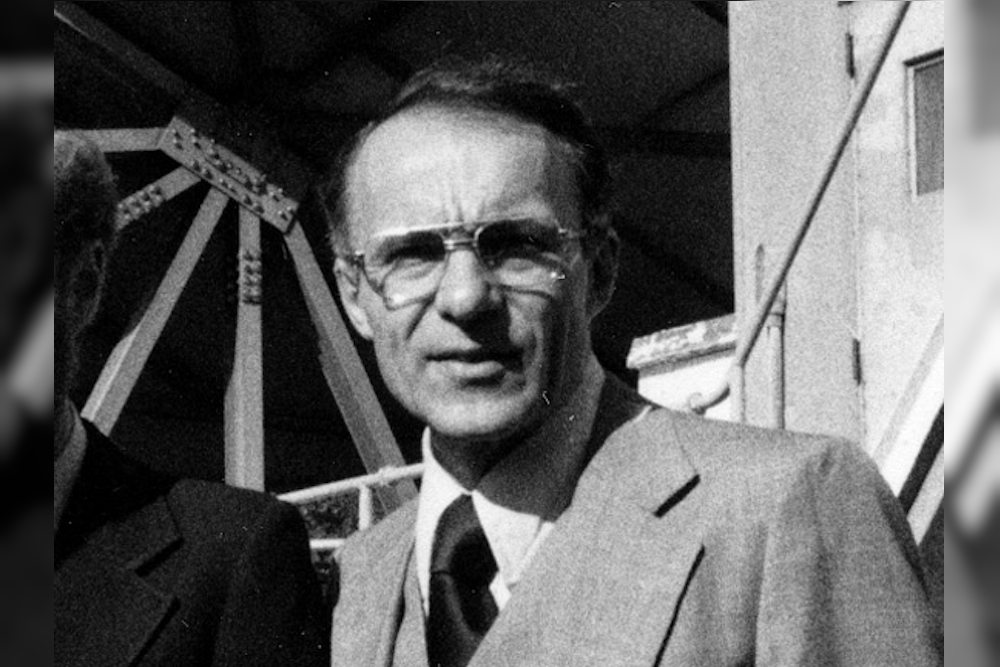
Arno A. Penzias was a scientist who shared the 1978 Nobel Prize in Physics for discoveries that helped prove the Big Bang theory.
- Died: January 22, 2024 (Who else died on January 22?)
- Details of death: Died in San Francisco of complications from Alzheimer’s disease at the age of 90.
- We invite you to share condolences for Arno A. Penzias in our Guest Book.
Arno A. Penzias’s legacy
Born in Germany to a Jewish family, Penzias and his younger brother were two of the thousands of Jewish children who were evacuated to England as part of the lifesaving Kindertransport. He was later reunited with his parents and the family settled in New York City as World War II still raged in Europe. In his new home, Penzias interrupted his college education to serve in the U.S. Army Signal Corps, then continued his path to a doctorate in physics.
Penzias was working for Bell Laboratories when his Nobel-winning research began. He and his colleague, Robert Woodrow Wilson, were using the company’s new satellite communications antenna to study deep space via radio astronomy. What he found was a hissing sound that he initially attributed to detritus on the antenna from roosting pigeons. However, the hiss persisted even after the antenna was cleaned. Penzias consulted with other physicists and ultimately concluded that the sound was cosmic microwave background radiation. This radiation was the last remnant of the explosion that gave birth to the universe, otherwise known as the Big Bang. Penzias’ and Wilson’s discovery of that radiation conclusively proved the Big Bang theory and disproved competing theories of the origin of the universe.
Penzias and Wilson shared the Nobel Prize for Physics in 1978 after publishing their observations of the cosmic microwave background radiation. Penzias remained at Bell for many years and eventually became vice president of research. In 2023, the Radio Club of America instituted a new award to be given in his honor, the Arno A. Penzias Award for Contributions to Basic Research in the Radio Sciences.
Penzias on the possibility of extraterrestrial life
“If we say that in our galaxy there are probably 200,000 million suns in our galaxy alone. And there are more than 100,000 million other galaxies. So think how many stars that is. And if among all those stars we are alone, we’re the only ones. I mean it just makes me shiver. It’s like you know you’re standing up, and you all of a sudden realize that there’s a cliff over here. It just makes me shiver. On the other hand if we’re not alone, it also makes me shiver.” —from a 2004 interview with Marika Griehsel
Tributes to Arno A. Penzias
Full obituary: The New York Times