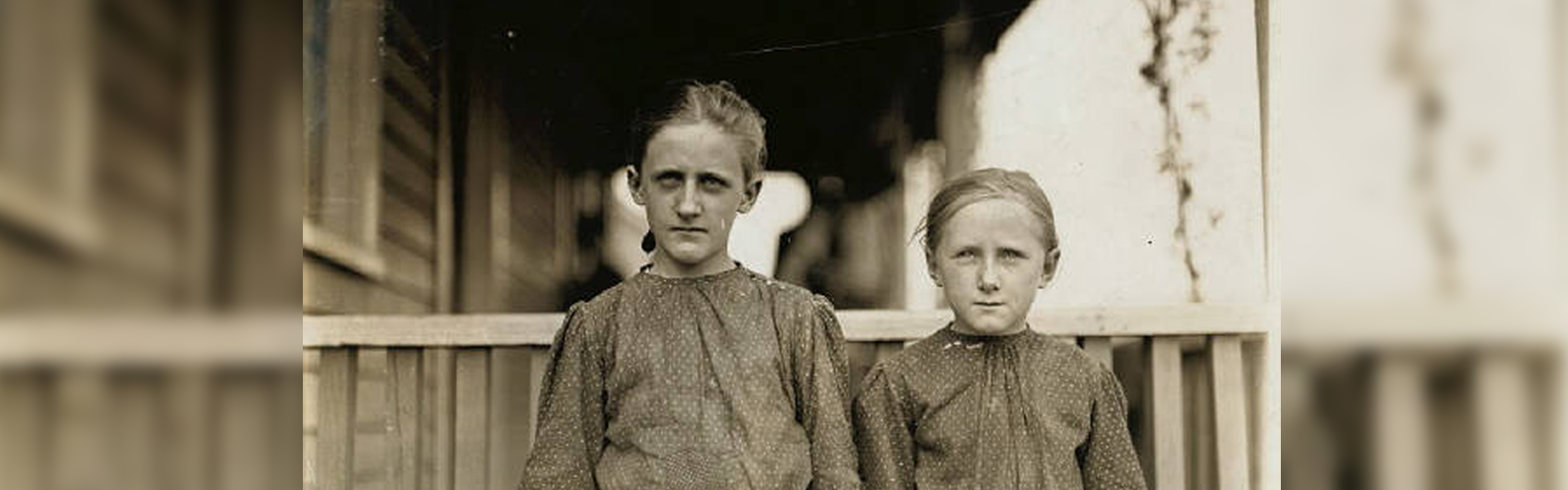
The Lewis Hine Project takes us into the working class world of 100 years through the faces of children.
In our era of quick-and-easy digital photography, camera phones and Instagram, one might guess that old photos would seem, well, old hat. Their colors are washed out or nonexistent, and they’re hard to share on social media, so they must be going the way of the dinosaurs.
As it turns out, nothing could be further than the truth. The more advanced our photographic technology becomes, it seems, the more we are fascinated with old photos. We apply filters to our Instagram shots to give them the appearance of a 1970s Polaroid or a 1920s sepia-tone photograph. Even better is the real deal itself – we can gaze endlessly at antique photos of people from days gone by, looking for clues about their lives and the very different world they inhabited.
The Lewis Hine Project takes us into that world through the faces of children – children who, a hundred years ago, worked to help feed their families. In the early 20th century, photographer Lewis Hine took thousands of pictures of child laborers in Pittsburgh and North Carolina, with his unflinching depictions of hard life at an early age eventually helping influence child labor law reforms in the U.S.

Original caption by Lewis Hine: “Oldest girl, Minnie Carpenter, House 53 Loray Mill, Gastonia, N.C. Spinner. Makes fifty cents a day for 10 hours. Works four sides. Younger girl works irregularly.” Hoping to learn more, Joe Manning researched and found Minnie’s death record and obituary. The obituary led him to a nephew who was excited to identify the second girl in the photo as his mother, Mattie Carpenter.
Decades later, author/historian/photographer Joe Manning discovered Hine’s photographs and began a huge undertaking: identifying as many of the subjects of those photos as possible and contacting their descendants. Along the way, he has uncovered fascinating stories and shed light on the lives and legacies of people who are long gone, but worth remembering.
Manning’s work on the project continues, and he’s seeking help identifying the people in a collection of “mystery photos.”
Visit the Lewis Hine Project website to learn more.
