The most-played song in U.S. radio history, "You've Lost That Lovin' Feeling,'' pulsed anew over the airwaves Thursday as fans mourned the death of the Righteous Brothers' Bobby Hatfield.
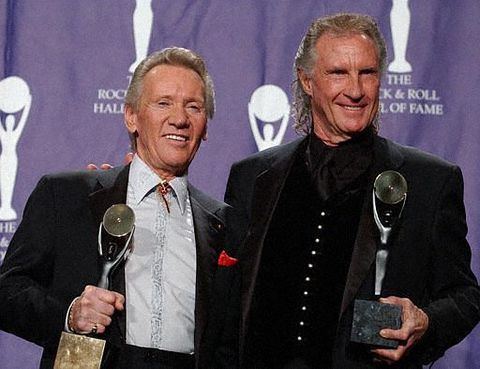
Hatfield, who with partner Bill Medley were inducted into the Rock and Roll Hall of Fame earlier this year, died Wednesday in a hotel room in Kalamazoo. He was 63.
Hatfield's body was discovered 45 minutes before the duo was to perform at Miller Auditorium on the Western Michigan University campus, manager David Cohen said. He was pronounced dead at 7:02 p.m. EST.
Preliminary results of an autopsy conducted Thursday at Sparrow Hospital in Lansing indicated Hatfield died of a heart attack, the Kalamazoo Department of Public Safety said in a statement.
Hatfield was a smoker, but Cohen said he was not aware of any chronic health problems afflicting the singer.
"It's a shock, a real shock,'' Cohen said, adding that Medley was "broken up. He's not even coherent.''
The Righteous Brothers, whose other hits included "Unchained Melody,'' `"You're My) Soul and Inspiration'' and "Rock and Roll Heaven,'' were in Kalamazoo to kick off four days of performances in Michigan and Ohio.
The duo's signature 1965 single, "You've Lost That Lovin' Feeling,'' has been frequently cited as the most-programmed song in American radio history. The inclusion of their songs in films such as "Top Gun,'' "Ghost'' and "Dirty Dancing'' repeatedly re-established the Righteous brand.
"The material is very strong,'' said Dick Clark, longtime "American Bandstand'' host who included the Righteous Brothers on numerous TV shows he produced. "The key to success is the material and putting your own signature on it. A lot of artists did their versions of those songs, but theirs was distinctive.''
Hatfield's soaring tenor and Medley's polished baritone were wrapped around pop tunes during the ascendancy of guitar rock. Their style was dubbed "blue-eyed soul.''
"Sometimes people with blue eyes transcended the limitations of what their color and culture can actually be,'' singer Billy Joel said during the Rock and Roll Hall of Fame induction ceremony for the duo. "Sometimes white people can actually be soulful. This was a life-changing idea. It changed my life.''
Speaking to reporters in March, Hatfield recalled that the "blue-eyed soul'' label came from disc jockeys, not him or Medley.
"It's kind of goofy,'' Hatfield said.
Robert Lee Hatfield was born Aug. 10, 1940, in Beaver Dam, Wis. His family moved to Anaheim, Calif., when he was 4. Hatfield organized singing and instrumental groups in high school while helping his parents with their dry cleaning business.
An avid athlete, Hatfield considered a career in professional baseball, but found his true calling in music -- a love he pursued while attending Long Beach State University, where he formed a band and performed at bars and proms.
Hatfield teamed up with Medley in 1962 as part of a five-piece group called The Paramours. According to the Righteous Brothers Web site, a black Marine called out during one of their performances, "That was righteous, brothers!''
They renamed themselves the Righteous Brothers before the release of their first album in 1963.
"You've Lost That Lovin' Feeling,'' the template for producer Phil Spector's "wall of sound'' technique, was released just as British rock 'n' roll was beginning to dominate U.S. record charts and airwaves.
"We had no idea if it would be a hit,'' Medley once said. "It was too slow, too long and right in the middle of the Beatles and the British Invasion.''
The performing rights organization BMI, however, has tallied about 8 million radio plays of the song.
After splitting up in 1968, the duo reunited in 1974 and returned to the top of the charts with "Rock and Roll Heaven.'' They performed sporadically, then went through another career revival in 1982.
Hatfield and Medley in later years routinely went on the road for 60 to 80 shows a year in addition to 12-week stints in Las Vegas, where they had found work as a lounge act during the dawn of their careers in 1962.
Hatfield is survived by his second wife, Linda, their two children and two children from a previous marriage.