Menu

Search by Name
Search by Name

Robert Griscom Obituary
Bob was the middle of seven children, born outside of Hempstead, NY, just after Christmas in 1930. He remembers being three years old and smacking his head on the bumper of a parked car on the snow-covered street as his dog Tin pulled him along the leash, chasing a cat under the car.
His father came from a long line of Quakers in the U.S. since the 1600s, and his mother descended from Spanish and French family lines. His maternal grandfather left Madrid to establish a flower and vegetable farm in Puerto Rico, before establishing his new company headquarters in New York and marrying his grandmother, whose own father had emigrated from France.
When he was five years old, his parents LeRoy and Mae moved their large family to Florida for his mother's health, first settling into Veterans Village, a 1,000 person housing project for veterans on a converted military base at Miami Army Air Field (today Miami International Airport). He was already enthralled with flying at three years old when while sitting outside in a playpen, he witnessed a biplane that had been putting along an open field crash into a tall tree. The pilot jumped out of the plane and walked away unscathed, and young Bob thought to himself, "That looks like fun!".
As a somewhat poor but smart kid from a large family during the Depression, he worked hard his whole life. Although he wasn't raised as a Quaker, qualities of fairness and justice were instilled in him from a young age. At a time when segregation was still legal and prominent throughout where they lived in the south, his dad used to say, 'You can't judge a man until you've walked in his shoes. Bob was more interested in a person's character than their background or social standing, or ethnicity. His father Roy also used to say that the Griscom family was like Heinz 57 ketchup, with its variety of ingredients making it especially good.
Bob did well in, but didn't particularly like, school and left before high school graduation after getting his start in aviation at 14 as a stock boy for the Miami airport's Eastern Airlines maintenance department. Doing a little stock car racing on the side, he progressed to the mechanics training program, earning his Airframe and Powerplant certificate in his late teens. Bob was good with his hands, and those jobs paid well, whereas becoming a pilot meant you had to pay for lessons…money he didn't have. His older brother Frank, who was already a military pilot, fulfilled Bob's dream by teaching him to fly, soloing a Stearman PT-17 at the age of 16.
When the Korean War broke out, Bob wanted to enlist in the Air Force, but they refused to train him as a fighter pilot because his aviation mechanic skills were more in demand. So, he walked out of the recruiting office across the hall to the Army and enlisted with them – yes, mostly out of spite! He served two years in Germany, rising through the ranks to Staff Sergeant and Tank Commander, doing what he later called 'playing war games with the Russians while he spent weekends riding a motorcycle exploring Germany and France, and taking extension courses to earn his AA degree from the University of Maryland at Munich.
After being honorably discharged, he returned to Florida to meet up with his older brother 'Speed,' a deep-sea salvage diver, who took him to the local bar to meet the barmaid he was dating. Turns out she took more of a liking to Bob, and within a year, they were married. Bob flew for a number of commercial and corporate outfits, including as chief pilot and manager for a cargo company flying between Miami and the Bahamas. Since the Bahamas were still being developed, a requirement of the job was to first build a runway, which Bob did, learning to run the machinery to personally construct the original airstrip at Freeport, Grand Bahama Island.
His first wife, Deena was a spirited woman in her own right, and in her, he found a kindred adventurer. They had three children, living in a trailer in Miami when it was still a relatively small town. They would hang out on the beach with his brother Speed and his new girlfriend 'Lucky' (no hard feelings, it seems), with Bob flying corporate and commercial aircraft. They lived for a year on Grand Bahama Island, then back to Miami, until the oldest child was ready for school when Deena insisted they move somewhere with better public schools. So after a brief stint outside Little Rock, Arkansas, hoping to make some money off a land sale and flying for Daisy Air Rifles (yes, the folks from "A Christmas Story… you'll shoot your eye out!"), they headed back to NY, settling on Long Island in the small commuter town of Oceanside, while Bob flew air taxi services and was a flight instructor at local airfields.
After a few years, he had a solid reputation around the airfield as a respected pilot, and a colleague recommended him to a family that was looking to hire a new co-pilot for their private corporate plane. Hungry for a steady job to support his family, Bob applied. Like the rest of the Griscom men, he could always tell a good story, and he would later describe the interview like this, "We had lunch at some fancy highfalutin' place in the city, the Wings Club in the PanAm building downtown. A bunch of guys were there: the pilot, the owner's son, and a few other people. While I was talking, the waiter served me a Salisbury steak, but it slipped off his tray and went flying, sauce and all, across the table and landed with a plop on the sparkling white tablecloth next to the salt shakers. So I kept talking and reached over with my fork, picked up the steak, and put it back on my plate while I continued answering their questions. I wasn't about to let that steak go to waste!" Well, he got the job. They later said they figured if he could keep his cool under that situation, he could keep his cool if there was a problem in the air. They were right. The owner's son at the lunch interview was then-Attorney General Robert F. Kennedy, who "was looking for a professional pilot, not a yes man," and the owner was 'the old man' Joseph P. Kennedy. The plane was the family's personal aircraft, the Caroline, which was eventually donated to the Smithsonian National Air and Space Museum in DC after nine years and 650,000 miles of service. The Caroline is recognized as the first privately owned aircraft to serve as the primary transport vehicle in a presidential campaign (JFK's).
Bob flew as co-pilot and then pilot for the Kennedys until the plane was retired in 1967. He ferried the family back and forth between their personal compounds in Palm Beach and Hyannis Port, as well as on family vacations and business and political meetings from the east coast to the heartland, along with friends, lawmakers, celebrities, and their extended families. On occasions when his employer didn't need him, they let him put his own family on board and fly to Florida to visit Bob's parents and brothers and sisters. Influenced by his upbringing and his own strong moral compass, he judged people by their character, not by their social or economic status. He was a professional pilot who took pride in doing his job well, keeping his passengers safe, and not taking unnecessary risks. He came to highly respect Bobby Kennedy, and while he might have admired some of his passengers more than others, he was always professional and never intimidated. There were times Bob refused to fly if he thought the conditions weren't safe, and although that drew the ire of some of the family members who were used to people doing what they were told, it earned him the respect of others. On one occasion, a family member (Teddy) hired a different pilot and plane to fly him on a trip that Bob had refused due to bad weather conditions. It turned out that they suffered a crash with fatalities, likely caused by the pilot trying to 'duck under, or get around, the poor weather conditions. After that incident, no one argued with Bob about when it was safe to fly. They trusted him with their lives and the lives of their children, and he never let them down.
When Robert Kennedy ran for president, Bob was put in charge of managing RFK's campaign flights around the country, but then Bobby was also assassinated. Around this time, a tragic accident took the life of Bob's son Jimmy, and he and Deena decided to pick up roots and start again someplace new. Bob retired from corporate flying and joined the FAA as an Air Carrier and General Aviation Operations Inspector. His family moved to San Diego in July 1969, about a month before the first moon landing. They bought a four-bedroom three-bath two-story home overlooking a canyon in University City for the seemingly outrageously high price of $40,000. He loved San Diego and never left.
Bob had a long distinguished career with the FAA. He certified commercial passenger and cargo pilots on a variety of aircraft, learned to fly hot air balloons and fixed-wing gliders so he could then certify those pilots, took the controls aboard his fastest flight with crew from Miramar Naval Air Station, oversaw safe flights at numerous aircraft shows, ensured air carrier safety compliance, recommended and implemented improved safety protocols, and investigated accidents, including a number of high-profile commercial aircraft crashes in SD, such as PSA Flight 182 in 1978. Bob also wrote and produced audio-visual education programs for professional and private pilots. He always wanted to know how and what happened, and work to prevent another such disaster.
Outside of work, he took his family camping in Baja California and the nearby desert (where they would never forget the first time seeing the Milky Way in it's amazing glory) and went on lots of road trips exploring the west coast. He was incredibly intelligent, someone who could read something complicated once and remember it forever, and taught himself any skill he was interested in, such as photography (also building a photo lab in his garage), trying his hand at gardening in his backyard, building a deck and doing numerous handyman jobs around the house, all the while enjoying a large circle of friends. He created a stable, comfortable home for his wife and two daughters. He took his family everywhere and taught his daughters Sharon and Rose both how to fly before they were 16. Although he never showed it, he was likely a bit disappointed that neither of them stayed with it to earn their pilot's license. Instead, they choose to spend the money on college. Later in life, he agreed that that was probably a good decision.
To plant trees in memory, please visit the Sympathy Store.
Memories and Condolences
for Robert Griscom
4 Entries
Iva Davis Platt Barbara Griscoms daughter.
June 20, 2022
What a beautiful tribute to my uncle. Mother always spoke of you Uncle Bob. How she loved you. Rest in peace. Give them all a hug for me..
Lorie Payne (Gina's Sister)
April 29, 2022
Dear Rose,
I just loved the obituary. Your father was such and interesting man, so many great stories. I loved the steak story, so funny.
So sorry for your loss.

Dave Johnson
April 23, 2022
My heart is softened by Uncle Bob's passing. May your comfort be found in warm memories and tender mercies. I remember being influenced by him in aviation when he was in Miami and I was just a boy, not even a teenager yet! That led to a career in aviation maintenance that now is approaching the 50 year mark which qualifies for the FAA Taylor award (Wright Brother's Mechanic who is the first A&P and built their engine for the Wright Flyer), oh i like to fly for fun too. Blue skies and tail winds Uncle Bob!
Carol Pittaluga
April 22, 2022
Sending out love and prayers to you and your family Rose. Your father sounds like someone who lived a life full of wonderful experiences. How lovely that you were able to be with him during his transition. As Rumi states, "Death has nothing to do with going away. The sun sets and the moons sets, but they're not gone" May the memories of your loved one forever bring you light and love.
How you can show support
Follow
Get email updates whenever changes are made.
Send flowers
Consider sending flowers.
Add photos
Share their life with photo memories.
Plant trees
Honor them by planting trees in their memory.
Donate in Memory
Make a donation in memory of your loved one.
Share this page
Invite other friends and family to visit the page.
Showing 1 - 4 of 4 results
Make a Donation
in Robert Griscom's name
Memorial Events
for Robert Griscom
People and places connected with Robert
Recent Obituaries
Recent Obituaries
Recent Obituaries
How to support Robert's loved ones

Should I Send Sympathy Flowers?
What kind of arrangement is appropriate, where should you send it, and when should you send an alternative?
Read more
What Should I Write in a Sympathy Card?
We'll help you find the right words to comfort your family member or loved one during this difficult time.
Read more
Resources to help you cope with loss

How to Cope With Grief
Information and advice to help you cope with the death of someone important to you.
Read more
Estate Settlement Guide
If you’re in charge of handling the affairs for a recently deceased loved one, this guide offers a helpful checklist.
Read more

Obituaries, grief & privacy: Legacy’s news editor on NPR podcast
Legacy's Linnea Crowther discusses how families talk about causes of death in the obituaries they write.
Read moreWays to honor Robert Griscom's life and legacy
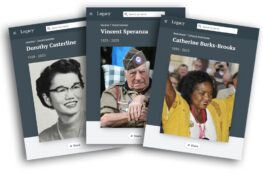
Obituary Examples
You may find these well-written obituary examples helpful as you write about your own family.
Read more

Obituary Templates – Customizable Examples and Samples
These free blank templates make writing an obituary faster and easier.
Read more
How Do I Write a Eulogy?
Some basic help and starters when you have to write a tribute to someone you love.
Read more


