Add a Memory
Make a Donation
Jeanne May Obituary
BY PATRICIA CHARGOT
FREE PRESS STAFF WRITER
On her first day on the job as a newly minted reporter, Jeanne May sat quaking in her seat at the Virginian-Pilot, in Norfolk.
She was the only woman in the newsroom. A fresh-faced 21-year-old with a shy smile and short, wavy red hair, she was surrounded by gruff, tough-talking, cigar-chomping men.
"If I had any doubt that I was in a man's world, it was dispelled when I found that I had not only my own desk and my own chair, but also my own brass spittoon," May, who was then Jeanne Smith, recalled in a talk several years ago to a women's group.
"I was sitting at my desk, looking at my hands and wondering what would happen next when I heard a rustling sound over my right shoulder. I looked up and saw a pygmy elephant with a dwarf riding on its back. The elephant was on a leash held by a giant. The entourage walked along the side of the newsroom and disappeared around the corner.
"As surprised as I was to see an elephant in the newsroom, I was even more surprised to find that I was the only reporter who was surprised. None of the men even looked up from what they were doing.
"Oh, my lord, I thought, what have I got myself into?"
What she got herself into was a business that for the next 45 years could be maddeningly difficult, but would "never fail to fascinate," May told the women's group in 2001.
Her speech was so engagingly written that it was excerpted in the Free Press during Women's History Month.
May, a Detroit Free Press reporter and pioneer among women in journalism, died Saturday at her home in Grosse Pointe Woods of cancer. She was 73. She had not yet decided to retire when she became so acutely tired late last October that she was unable to work and took to her bed.
She never returned to the Free Press, setting off a wave of sadness that quickly spread to many other newspapers where she had friends.
"Jeanne did distinctive and award-winning journalism for the Free Press for a quarter century, but I think some of her most important work for our readers came in recent years, when she took on the full-time role of crafting news obituaries," said Carole Leigh Hutton, the Free Press publisher and editor.
"She was able to show that even the most ordinary lives are extraordinary in their own ways. I loved to share with her the frequent praise and thanks I got from family and friends of her obituary subjects. She touched a lot of lives, and I think she understood it truly was special."
But May also produced many longer, more complex stories, adhering to a favorite maxim by mid-19th Century Free Press editor Wilbur Fisk Storey: "It is a newspaper's duty to print the news and raise hell."
She was one of the paper's most versatile reporters, excelling at everything from light-hearted features to hard-hitting investigative pieces.
In 1990, she helped report and write "Workers at Risk," a three-part series on the dangerous working conditions and rise in injuries at nonunion plants supplying car parts to the Big Three automakers. The series won several awards, including a first place for print journalism and the grand prize in the prestigious Robert F. Kennedy Journalism Awards.
May was born in Chattanooga, Tenn., and reared there and in Ohio, Alabama, Illinois and Michigan, graduating from what is now Grosse Pointe South High School. In 1953, she graduated from Northwestern University, where she majored in journalism and economics.
At the Virginian-Pilot, she fell in love with Ronald May, a political columnist who was nine years her senior, and broke her engagement to someone else in Chicago. Last year, she wrote about their meeting, and marriage, for a young reporter after the two talked about finding love.
"I was just swept off my feet," May wrote. "If he'd told me to jump off the building, I'd probably have done it. I don't remember any thought process in the thing. I was just compelled. I was 23 years old."
May was an assistant city editor when she retired from the paper to become a housewife and mother. But her husband soon died suddenly, leaving her with two sons, a toddler and an infant. Two years later, she returned to journalism, working for the next 20 years as a chief copy editor -- first at the Morning News in Wilmington, Del., then at the Globe-Democrat in St. Louis and then the Detroit Free Press.
One day in 1983, "I was filing some old papers and came across a letter from the man who had hired me at the Free Press," she said in her 2001 speech.
"He was responding to a letter I'd written him, and he said, 'Why are you editing? You write like an angel.'
"Write, I thought. Write."
She did, spreading her wings and hitting the streets with the energy and enthusiasm of a much younger reporter. But she was more than just "a complete pro," said former Free Press investigative reporter Michael Wagner. She became the still center of the turbulent newsroom, a kind of den mother, soothing egos, telling funny stories, listening to every ilk of complaint. Her preferred exclamatory, the archaic "gadzooks," suited her perfectly. So did pearls.
Once, on a rough helicopter flight to check out a brush fire, May even offered to hold a puke bag for a Free Press photographer.
"I would throw up, and then I'd hand the bag to Jeanne," said Patricia Beck. "Then I'd take a picture. Then she'd hand the bag back and I'd throw up some more. She said, 'Don't worry. I'm a mom. I've done this before.' She was great."
Over the years, May baked enough birthday cakes for coworkers to stock a bakery. She stitched enough samplers commemorating weddings, births and other occasions to fill an art gallery. Until recently, she wrote letters to about 90 family members and friends at Christmas -- individually composed.
A Free Press card recently sent to her home was covered with good-bye messages, including these:
"Jeanne, you are a gem and a treasure." "A genuine class act." "I miss you so much. Thank you for everything."
And just: "We love, you, Jeanne." Surviving are her sons, Ronald Jr. and John; a brother, Neil Smith, and a grandson, Olin Meyers.
A memorial service will be held at noon Saturday at A.H. Peters Funeral Home, 20705 Vernier, Grosse Pointe Woods.
Burial will be in Arlington National Cemetery, Va., next to her husband. Memorial donations can be made to the Juvenile Diabetes Research Foundation International.
1 Entry
Sandy McClure
January 10, 2005
I was shocked and saddened today to learn of Jeanne's death. I knew her in the "Old Days" at the Free Press and always have considered her one of the best. We will miss her caring heart, gentle style, and great humanity.
How you can show support
Showing 1 - 1 of 1 results
Make a Donation
in Jeanne May's name
People and places connected with Jeanne
Recent Obituaries
Recent Obituaries
How to support Jeanne's loved ones
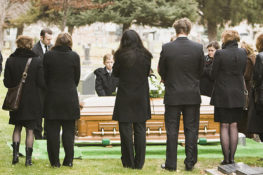

Should I Send Sympathy Flowers?
What kind of arrangement is appropriate, where should you send it, and when should you send an alternative?
Read more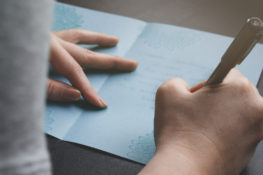
What Should I Write in a Sympathy Card?
We'll help you find the right words to comfort your family member or loved one during this difficult time.
Read more
Resources to help you cope with loss

How to Cope With Grief
Information and advice to help you cope with the death of someone important to you.
Read more
Estate Settlement Guide
If you’re in charge of handling the affairs for a recently deceased loved one, this guide offers a helpful checklist.
Read more

Obituaries, grief & privacy: Legacy’s news editor on NPR podcast
Legacy's Linnea Crowther discusses how families talk about causes of death in the obituaries they write.
Read moreWays to honor Jeanne May's life and legacy
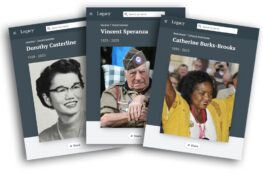
Obituary Examples
You may find these well-written obituary examples helpful as you write about your own family.
Read more

Obituary Templates – Customizable Examples and Samples
These free blank templates make writing an obituary faster and easier.
Read more
How Do I Write a Eulogy?
Some basic help and starters when you have to write a tribute to someone you love.
Read moreMore ways to support the family
Visit the Sympathy Shop
Sponsored