A Love So Strong
by Legacy Staff
by Legacy Staff
6 min readWhat happens when two people literally can't live without each other?
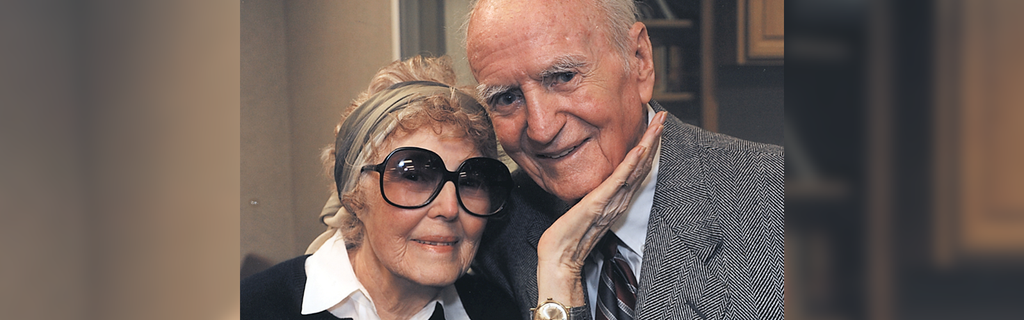
 As Les Brown lay dying of complications from Parkinson's disease, his wife of 75 years, Helen, confided in their son.
"She said she did not want to see my Dad die, and she did not want to live without him," Daniel Brown said in an interview with Legacy.com. "It was one of the last conversations we had."
Her husband already in a coma, Helen died July 16. Les died the next day. Born on the same day in 1918, the Browns were 94.
It is unknown if Les, in his unconscious state, was ever aware that his wife was gone. But it's possible, Dan said.
"Every day, my mom would go into his room and kiss him and stroke his cheek and hold his hand," Dan said. "He might have had a feeling."
There's something incredibly romantic about this idea of a love so strong a couple cannot be parted. In his song "The Luckiest," Ben Folds describes true commitment this way, "Next door, there's an old man who lived ‘til his 90s and one day, passed away, in his sleep. And his wife, she stayed for a couple of days and passed away."
And there's a quote – often attributed to A.A. Milne but of unknown origin – that's been used in countless wedding programs, "If you live to be 100, I want to live to be 100 minus one day, so I never have to live without you."
But there is evidence some physical links may exist between these joined partings.
Researchers have been talking about the "widower effect" for generations. In a 2006 study, Harvard researchers looked at more than 500,000 couples aged 65 or older. They found that men who lost their wives were 53 percent more likely to die within the next 30 days. The death of a husband increased a wife's risk of dying by 61 percent.
One of those Harvard researchers, Nicholas Christakis, did further research and later co-wrote a book that stressed the importance of social networks on health. A death often shakes those social foundations.
Barbara Resnick, a geriatric nurse practitioner and the past president of American Geriatric Society, agrees that human connections are paramount. In her experience, one partner becomes the caregiver for other, putting the ailing person's health and needs first. Often, that's at the caregiver's detriment.
"People get worn out. They don't take care of themselves," Resnick said.
Sometimes, these caregivers ignore their own ailments to focus on their partner. Helen Brown "was very focused on taking care of (her husband) to the point where she wasn't focusing on her own health," son Dan said. After months of fatigue and abdominal pain, she went to the doctor and found out she had stomach cancer. The prognosis: She had only a few months to live.
She actually died much sooner than that, and a day before her ailing husband.
"In a way, it worked out well," Dan Brown said. "Almost a blessing."
"Blessing" is the same word Margaret Knapke of Dayton, Ohio, used to describe her parents' recent deaths. Harold and Ruth Knapke died within 11 hours of each other on August 11. Harold was 91. Ruth was 89.
"We weren't expecting to lose them together, and it's a double loss and so hard to believe, but it's also consoling," Margaret Knapke said in an interview with Legacy.com. "It's impossible to think about one surviving any length of time without the other. They were too close for that."
 Harold and Ruth Knapke, June 2013 (Image courtesy of the Knapke family)
The couple went to the same elementary school -- Ruth told her children that her second grade self had a crush on Harold, a handsome third grader. But Harold soon moved away and then went to a different school and then college and he eventually joined the Army during World War II.
Stationed in Germany, Harold met another soldier from Ohio. That soldier turned out to be married to Ruth's sister, and he wanted to play matchmaker.
Initially connected by letters, the couple courted for two years before marrying in 1947. They had seven children, including a son who died as an infant.
"When I was a little kid, I just looked at them as my parents, not two people who were in love with each other," Knapke said. "But since they died and we've been going through these old photos, it's obvious they were crazy about each other."
In the couple's later years, Harold was the more fragile of the two. For the last year, he slept most of the day. "We'd ask, 'Why do you suppose he's still here?' and the only answer we could come up with was he didn't want to leave mom behind," Knapke said.
Then Ruth's health took a turn. Soon, both required constant care. The family found a nursing home with a double room available. The Knapkes moved in.
"They were very aware of each other," Knapke said. "At times, we'd put their beds together so they could hold hands."
On August 8, Margaret Knapke and her siblings told their father that it was clear Ruth was close to death. "We didn’t want him to be surprised," she said. "He was a man of few words and didn't want to talk about it, but we could really see he was processing a lot that night. He was really thinking hard."
 Jerome and Diane Pawlak, Image via Milwaukee Journal Sentinel
The death of Jerome, 86, had been expected. Months earlier, he'd been diagnosed with leukemia and was hospitalized with complications when he died. Diane, 81, sitting by her husband's bedside, seemed well until her final breath. She was sitting on a chair, holding her husband's hand, when she said, "Good bye, Jerry. You can go."
Then she clutched her chest and slumped back in her chair. Rushed to the emergency room, doctors said she had died of an apparent heart attack. And in the minutes since she had left her husband's room, he had died, too.
Their sons told the Journal Sentinel the almost simultaneous deaths were a blessing.
"In a sense," one said, "we take relief that there was no suffering."
Natalie Pompilio is a freelance writer based in Philadelphia. Her lifelong love of obituaries raised eyebrows when she was younger, but she's now able to explain that this interest goes beyond morbid curiosity. Says Pompilio, "Obituaries are mini life stories, allowing a glimpse into someone's world that we're often denied. I just wish we could share them with each other when we're alive."
TAGS