
Herb Drower Obituary
As president of the Chicago-based plastics company Transilwrap, Herb expanded its operations and ambitions. He founded the company's manufacturing division and grew its footprint globally. Along the way, he earned more than a dozen patents, and he and his beloved wife, Sara (Minkus) Drower, traveled to every continent except Antarctica. He never stopped learning, exploring and doing.
Born in 1932, at the height of the Depression, Herb grew up in a working-class family on Chicago's West Side. Although he shared his name with the sitting president, he had actually been named by his aunt after a popular bandleader she liked at the time.
His father, Joe Drower, a decorated World War I veteran, managed a liquor store. His mother, Dorothy (Bernstein) Drower, was a homemaker with a strong sense of right and wrong. Herb's birth had been a surprise. His twin sister, Marlene, was born 10 minutes before him. When the nurse came into the waiting room again to report Herb's birth, his father thought it was a mix-up. His mother had no idea she had been carrying twins.
Herb's older brother, Merritt, who was five years his senior, had a serious illness that required him to be hospitalized for long stretches. When Merritt was feeling well, though, he took on part-time jobs and used his wages to help provide for his younger siblings. When Herb joined the Boy Scouts, Merritt paid for his uniform, equipment and fees. It was a gesture Herb never forgot, and one that may have helped inspire his future pay-it-forward philosophy in life.
Although he was the baby of the family, Herb wasted little time in making himself essential. When he was around 12, his mother asked his father to hang a painting. "Dorothy," his father replied with a sly smile, "you know I don't know how to use a hammer." She simply handed the tool to Herb and, before long, he was the family handyman. Later in his life, he became an accomplished woodworker who built furniture and even a garage. Nicknamed "Mr. Fix-It" by his family, he kept a basement workshop so extensive that it earned a profile in the local newspaper.
A proud product of Chicago Public Schools and president of his senior class, Herb took the name of his high school – Marshall – as his middle name. Scarlet fever robbed him of hearing in his left ear as a boy, establishing his lifelong pattern of dealing with ailments without complaint. He liked being called Lefty, since he was a rare southpaw in his day who (with his mother's support) managed to resist efforts by teachers to make him conform to the right-handed world. He was so good at his part-time job at a lamp store that the owner offered to set him up as manager of a new store. Herb politely declined; he wanted to go to college and see the world.
He was able to afford his freshman year at the Illinois Institute of Technology only because he won a competitive scholarship. He arrived early for the scholarship interview and watched as several other candidates struggled with a tricky door knob to get into the conference room. By the time it was his turn to meet with the selection committee, Herb knew exactly how to turn the knob to get the door open without any fuss. Since the scholarship was meant for students with a technical mind, Herb often wondered if the committee had used the tricky door knob as an aptitude test. He saved money during his sophomore year by attending the public college campus at Chicago's Navy Pier. By his junior year, he had saved up enough money working multiple jobs to afford his two final undergraduate years at Northwestern University's business school.
He loved the open road – driving his family on car trips in the 1950s to Florida, California and Canada. A natural entrepreneur, Herb in his mid-twenties cashed in a life insurance policy to invest in a small start-up called Sir Sandwich. The company sold high-speed infrared ovens and hamburgers to bowling alleys, taverns and other businesses too small to have commercial kitchens. He soon became its vice president of sales, expanding the company as he traveled the Midwest by car. In the hopes of covering even more territory, he became a part-owner of a small fixed-wing airplane and began taking flying lessons.
He thrived in business despite refusing to take the shortcuts so common in the sales world. He had a Boy Scout's honesty about him. He made no attempt to disguise the fact that he didn't follow professional sports, even though that kind of talk lubricated so many business transactions in sports-obsessed Chicago. Many diners comb their restaurant checks looking to catch overcharges; Herb did the opposite, often calling over a server to insist that he pay for something that had been inadvertently left off the bill. Once, when someone was about to sign the final paperwork to buy a franchise as part of Sir Sandwich's expansion, the man asked Herb, "You think this would be a good move for me, right?" As much as Herb believed in the business and stood to profit from the franchise sale, he told the man the truth: No, it wasn't a good fit for him.
Herb's life was never the same after he attended a pre-Valentine's Day party on Feb. 12, 1961. He met a smart Audrey Hepburn look-alike named Sara, and they fell into an easy conversation. When he looked for her at the end of the night, he was disappointed to discover she had left without saying goodbye. He learned that she had taken a ride home with another guy, but not intentionally. Because she wanted to look her best at the party, Sara had purposely not worn her eyeglasses. She ended up taking a ride home with a man who looked like Herb, at least to someone with uncorrected astigmatism.
Herb made the most of second chances. He quickly arranged for a dinner date with Sara, taking her to a classy but affordable Italian restaurant. They discussed their shared interest in a life of travel and adventure. (With a group of fellow college students, Sara had already ventured where few Americans had been by the early 1960s, behind the Iron Curtain of Eastern Europe and the Soviet Union.) They followed up their first date with another half-dozen over the next week or so.
Two weeks after meeting her, Herb asked Sara to marry him. It was all so sudden that Sara's mother, Rachel Minkus, asked her daughter, "Is there something you need to tell me?" There wasn't, except, as Sara and Herb would both explain, "When you know, you know." They married four months later. Herb had just turned 29. Sara was 22. They delayed their honeymoon to the following winter, when they could afford an off-season budget trip to Europe, exploring Franco's Spain and Salazar's Portugal.
Ahead of the wedding, Herb made two big changes in his life. He left the Sir Sandwich startup, knowing the punishing travel demands would be incompatible with a successful married life. And, at his future mother-in-law's insistence, he agreed not to fly his airplane until after the wedding. As he would later joke, "She had already spent a lot on stationery and postage, and she didn't want that to go to waste." He decided to sell his stake in the plane altogether.
A few years after Herb left Sir Sandwich, The Hershey Company bought it for several million dollars. Herb said he never regretted missing out on that big payday. By then, he was already thriving in his new role with Transilwrap, the plastics company his father-in-law, David Minkus, had cofounded in 1931. One of the first converters and distributors of film in the plastics industry, Transilwrap began by turning large cellophane rolls into smaller rolls for the candy industry. Later, it moved into the production of laminated ID cards, buying laminating film from other suppliers. Herb spied an opportunity, persuading his father-in-law to let him start a separate business called Sealtran, which manufactured thermal laminating film. Motivated by his bottomless curiosity, technological savvy, and gift for innovation, Herb built Sealtran into such a thriving concern that they combined it with Transilwrap. It became the cornerstone of the larger company's manufacturing division, representing about one-third of Transilwrap's overall business, and contributing an even higher percentage to its bottom line.
Herb appreciated the vital lessons he learned from his father-in-law about the right way to run a business and treat employees. After David Minkus died in 1976, Herb became vice president and his brother-in-law, Mort Minkus, its president. Herb marveled at how well he and Mort worked together – they could heatedly debate a difference in opinion over strategy and then smoothly shift into a laugh-filled lunch. After Mort's untimely death in 1993, Herb took over as president and later became chairman.
He loved a good challenge, especially when trying to drum up new customers in high-pressure New York City. Once, after Herb cold-called a big business in Manhattan, the guy in charge gruffly told him, "You've got five minutes." That man not only went on to become one of his biggest customers but also a lifelong friend.
By the late 1960s, Herb and Sara had two daughters, Debora and Denise, and had moved from Chicago to the city's north suburb of Wilmette. In the early 1970s, they began their tradition of taking the girls on Herb's overseas trips to widen the family's horizons, both business and personal. Herb would line up potential new customers. Sara would plan elaborate itineraries, often to the least traveled sections of the countries they were visiting. These began in Brazil, where the family traversed the piranha-dense rivers of the Amazon.
The trips became only more ambitious and exotic, inspired not just by business prospects but also Sara's interests and contacts as an artist. (Herb once grew a beard, and Sara lobbied him to keep it because it made him fit in better with her artist friends. His chin was never bare again.) They went on a rare trip to China in 1978, as part of an artist exchange. They visited Burma and Kenya (twice each) in the 1980s. In 1989, they traveled around the Soviet Union, just as its hold on Eastern Europe was crumbling. The adventures continued in the 1990s, including to the Indian city of Bhuj, near the border with Pakistan, and to Tierra Del Fuego, at the southernmost tip of South America. Herb said his favorite destination was Burma because the Mandalay region wasn't just a trip to a different place but to a different time.
He and Sara would divide up the survival language duties – he took the lead with Spanish, German/Yiddish, and Chinese while she focused on French, Portuguese and Japanese. In later years, he and Sara passed on their love of exploration to the next generation, traveling with Denise and her husband, Neil Swidey, and their three daughters – Sophia, Nora and Susanna. They journeyed together to far-flung destinations ranging from Havana to Shanghai.
Herb warmly embraced his Jewish heritage and culture. Yet he had no interest in religion, calling himself a "devout atheist." He inherited from his mother a low tolerance for hypocrisy. His grandfather was a mohel, and his great uncle was a prominent rabbi who had his own radio show. Herb's older brother met regularly with a different rabbi in preparation for his bar mitzvah, until his mother saw the man hit her older son for getting an answer wrong. That put an end to his – and Herb's – religious training. It troubled his mother that the prominent rabbi with the radio show was also a slumlord.) However, Herb always loved spending time with extended family as they enjoyed the warm traditions and abundant food associated with the Jewish holidays. He referred to himself as a "stomach Jew."
His encyclopedic command of the intricacies of Chicago's street grid rivaled just about anyone born after Mrs. O'Leary's cow remade the city. Although he didn't follow pro sports, he participated in a wide variety of recreational sports: Weekly tennis games with his friend John Yoder. Sailing Lake Michigan with his brother-in-law Mort on the small boat they co-owned. Skiing with Debora and Denise on (what passed for) mountains in the Midwest. During her college years, Denise got into jogging and, on a family trip to San Francisco, he accompanied her on a run. When he returned home to Wilmette, he immediately bought a treadmill. He continued his treadmill workouts until he was in his late eighties.
Herb was an inveterate reader, a confident crossword-puzzle-solver, and, above all, an original thinker. He devoured books but was unsentimental in throwing them out after he finished the last page. He was also a tech early adopter, so he saved more than a few trees when he eagerly transitioned to a digital reader. Throughout his life, he worked hard to stay ahead of the curve, and he especially enjoyed trading tech advice with his three granddaughters, whom he adored.
A lover of Broadway showtunes, he amassed a collection of albums that topped 1,500. He and Sara made regular trips to New York to catch the latest shows. He most loved the classics like Showboat and said the mark of a great musical was if you walked out of the theater humming one of the tunes. He had no problem challenging conventional wisdom, though. During an early performance of Hamilton, he was unimpressed and dozed off.
Herb had a built-in sense of ethics and an impeccable sense of timing. He passed up the chance to sell Transilwrap for a big initial payout. Instead, he arranged to sell the company to a group of the managers he had long mentored and who had been instrumental in its success. He was especially proud to hand over leadership of the company to his prote ge and cousin Mark Stevens. At the height of the pandemic in 2020, he and Sara moved to Boston to be closer to Denise's family. (Debora, a graphic designer, lives in Minnesota.) Ahead of the move, he packed his essential belongings into two suitcases and had no problem giving away all of his extensive collections, from the cases of Broadway albums to the vast array of tools in his workshop. Just like proposing to Sara after two weeks, he said, "when you know, you know."
In his retirement, he continued to tinker and invent. While most of his patents involved commercial manufacturing, one of his creations – the GripClip holder – became a consumer product sold at big-box stores.
As a Depression baby, Herb had known lots of scarcity in his young life. When he found success later in life, he attributed it not just to his talent and drive but also to heaping amounts of good luck. That's why he was such a strong supporter of organizations devoted to helping people reach their full potential, regardless of family income. Herb and Sara were uninterested in most of the trappings that came with a comfortable life. Until moving to Boston, they lived in the same three-bedroom house for half a century and both drove older-model Toyotas. Their only indulgence involved good food and travel. When Denise became a chef and TV culinary producer, they stepped up the scope of their food-focused trips even more. Sara specialized in scoring impossible-to-get reservations at the world's top restaurants. For Herb, the one non-negotiable for travel was getting "a good story," even if that story emerged as a result of something going wrong. (Just one example: The time they landed in Greece on Christmas Day and found every restaurant closed, so they ate a dinner of crackers off the hood of their rental car.) Herb liked to talk about how he and Sara once went on a trip to Bermuda that was lovely in every way "except it didn't give us a single story." He retold that one so often that, in the end, it, too, turned into a good story.
Herb lost his mother when she was in her fifties, and his father and both of his siblings when they were in their sixties. So he knew that every day was a gift not to be wasted.
His survivors, in addition to his wife, Sara, include daughter Debora Drower (and her partner Bill Fricke) of St. Paul, MN.; daughter Denise Drower Swidey and son-in-law Neil Swidey and granddaughters Sophia, Nora and Susanna Swidey, who live outside Boston, MA. He also leaves a number of nieces, nephews and cousins.
Every Feb. 12, he and Sara celebrated their "Metcha Day," and this year they marked a big milestone. "I've had a wonderful life," he said recently. "My wife and I will have been married 65 years come June. I've loved her every minute of it." Talk about a good story.
At Herb's request, there will be no memorial service. The family asks anyone wishing to remember him to follow his example and find a way to pay it forward -- such as through a donation to the new Herb & Sara Drower Next Step Fund of the Alray Scholars Program (https://alray.org/herb-and-sara-drower-next-step-fund/), or to any nonprofit doing good work.
To plant trees in memory, please visit the Sympathy Store.
How you can show support
Follow
Get email updates whenever changes are made.
Send flowers
Consider sending flowers.
Add photos
Share their life with photo memories.
Plant trees
Honor them by planting trees in their memory.
Donate in Memory
Make a donation in memory of your loved one.
Share this page
Invite other friends and family to visit the page.
0 Entries
Be the first to post a memory or condolences.
287 Main St, Malden, MA 02148
Make a Donation
in Herb Drower's name
People and places connected with Herb
Recent Obituaries
Recent Obituaries
Recent Obituaries
Recent Obituaries
How to support Herb's loved ones

Should I Send Sympathy Flowers?
What kind of arrangement is appropriate, where should you send it, and when should you send an alternative?
Read more
What Should I Write in a Sympathy Card?
We'll help you find the right words to comfort your family member or loved one during this difficult time.
Read more
Resources to help you cope with loss

How to Cope With Grief
Information and advice to help you cope with the death of someone important to you.
Read more
Estate Settlement Guide
If you’re in charge of handling the affairs for a recently deceased loved one, this guide offers a helpful checklist.
Read more

Obituaries, grief & privacy: Legacy’s news editor on NPR podcast
Legacy's Linnea Crowther discusses how families talk about causes of death in the obituaries they write.
Read moreWays to honor Herb Drower's life and legacy
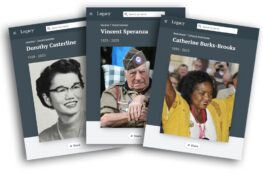
Obituary Examples
You may find these well-written obituary examples helpful as you write about your own family.
Read more

Obituary Templates – Customizable Examples and Samples
These free blank templates make writing an obituary faster and easier.
Read more
How Do I Write a Eulogy?
Some basic help and starters when you have to write a tribute to someone you love.
Read more


